


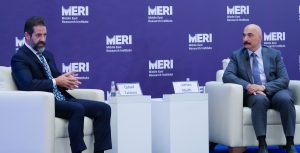
This panel brought together Qubad Talabani, Deputy Prime Minister of the Kurdistan Region of Iraq (KRI), and former federal minister and academic Torhan Mufti to explore the shifting relationship between Baghdad and Erbil, the unresolved structural weaknesses of Iraq’s federal system, and the political and administrative future of important areas such as Kirkuk. What emerges is a picture of mutual fragility: a federal centre heavily dependent on oil mired in incomplete legislation, and a federal region whose security and prosperity are inextricably tied internal unity and linkage to Baghdad. The discussion is strikingly self-critical and forward-looking, emphasising institutionalisation, decentralisation and Kurdish unity as the indispensable ingredients of a more stable shared future.
Beyond Mood Swings: Institutionalising Baghdad–Erbil Relations
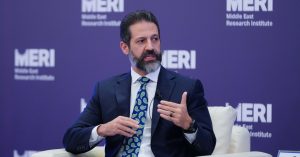
Asked to evaluate the relationship between Baghdad and Erbil, Qubad Talabani began with a careful distinction between the current mood and the structural reality that underpin the ties between the two. At the moment, there is coordination and an understanding in place; salaries are being prepared; tensions are manageable. But, he warned, this can change “tomorrow”. The real problem lies in a relationship conducted through personal moods, episodic bargains and political atmospherics rather than through stable institutions.
For Talabani, even the phrase “Baghdad–Erbil relations” is part of the problem. Erbil is the capital of the Kurdistan Region, not a party or faction; Baghdad is the capital of all Iraq, not of one bloc or sect. Yet in practice neither capital fully represents its formal constituency. The remedy, in his view, lies in:
- grounding the relationship firmly in the Iraqi constitution; and
- building institutional ties, ministry to ministry, parliament to parliament, rather than leader-to-leader understandings that are “good one day and bad another.”
He also introduced a key strategic concept: Baghdad as the KRI’s “political depth”. The KRI’s strategic horizon, he argues, lies not in parallel or separate structures, but in influencing decisions at the federal centre. He was explicit that his own party, the Patriotic Union of Kurdistan (PUK), has consciously shifted to strengthen its presence in Baghdad so that Kurdish interests are defended and negotiated there, not only in Erbil or Sulaymaniyah. At the same time, he insisted that Iraq must internalise the reality that it is a federal state and that the KRI is a constitutional federal entity with defined rights and responsibilities.
The constitutional text alone, however, is not enough. Many implementing laws, especially those needed to fill “constitutional gaps”, have simply never been passed by Parliament. These cannot be written in Erbil or Sulaymaniyah; they must be enacted in Baghdad, and this requires Kurdish strength and unity there, Mr. Talabani stated.
The Missing Oil and Gas Law: Iraq’s “Economic Constitution”
Both speakers converged on the centrality of an oil and gas law as a foundational piece of Iraq’s economic architecture. Torhan characterised it as the country’s economic constitution: a framework that would clarify ownership, management and revenue-sharing for oil, gas and other natural resources. Without it, ambiguity reigns, and “the window is open” to ad hoc deals, conflicting interpretations and political manipulation.
Talabani recalled multiple attempts to pass such a law, drafts in 2007, 2010, 2012 and 2018, but noted that each government has ultimately deferred the issue to its successor. The reasons may be many: reluctance to relinquish central control, fear of empowering regions and governorates, or a general political preference for discretionary control over even transparent rules. Whatever the cause, the consequences have been severe:
- Iraq, a country of around 46 million people, has effectively one main source of income but no law regulating it. Talabani called this a “disaster”.
- The absence of a clear legal framework has fueled recurring disputes between Baghdad and the KRI over authority and revenues.
- International companies face uncertainty and increased risk. Some operate in Iraq, but their “insurance cost” is high without a robust legal environment to protect contracts and investments.
For Talabani, a properly ratified oil and gas law would not only serve Kurdistan, but also other resource-rich areas such as Basra and Anbar. It would signal seriousness, attract investment, and move Iraq away from rule by interpretation and “personal moods” toward rule by law. Mufti agreed that as long as oil and gas constitute roughly 88–89% of the budget, the temptation to postpone such a law will remain strong; yet this postponement may only deepen structural dependence and vulnerability.
Talabani linked this directly to the need for economic diversification. Once an oil and gas law is in place, Iraq must invest in agriculture, clean energy and other sectors. He warned that if oil prices drop to 40–50 USD per barrel, the crisis will not be limited to the KRG’s salaries; it will engulf Basra and the rest of Iraq. Policymakers, both federal and regional, must therefore develop long-term plans for such scenarios and governments must execute them.
Salaries, Sovereignty and the Culture of Federalism
When Mufti pressed for practical measures to ensure the regular flow of salaries from Baghdad to the KRI, Talabani pointed to the absurdity and fragility of the current arrangements. Each month, lists are sent, revised, audited, returned and corrected in a laborious back-and-forth that produces sustained anxiety among public servants. Neither Baghdad nor Erbil is satisfied with this process, yet it persists.
Talabani linked this to a deeper question: Is Iraq truly an independent state capable of making decisions in its own interest, or is it heavily constrained by regional and international politics? As long as Iraq’s budget politics are hostage to short-term political calculations and external alignments, the KRI’s fiscal position will remain precarious. The answer, he argued, once again lies in Kurdish political strength in Baghdad, acting on the basis that “we are part of Iraq” and must care about Iraq’s overall direction, not just our own region.
Mufti, drawing on his own experience in government, noted that in a federal system with multiple layers-central, federal, devolved units- tensions between the centre and sub-units are normal. In Iraq, this friction is especially acute between the federal government and the KRI, but it is not unique: provinces like Basra also feel neglected. The real challenge is to build a culture of federalism in which ministers in Baghdad understand that Iraq now has nineteen provinces, each with its own government and authorities, plus a federal region with its own parliament and cabinet.
According to Talabani, this requires:
- fully internalising constitutional limits and competences; and
- appointing qualified, competent people at all levels, ministers, deputy ministers, director generals and advisers, who understand federalism and know when coordination is required rather than unilateral decision-making.
Without such human and institutional capacity, federalism remains a text on paper rather than a lived practice.
Decentralisation Within the KRI: Halabja, Ranya and the Limits of Symbolism
The conversation then turned inward, to the question of decentralisation within the KRI itself. Talabani was unequivocal: “100%” there is a need for greater decentralisation inside the Region. Just as the KRI demands devolved powers from Baghdad, it must also devolve powers from Erbil to provinces, districts and sub-districts.
He stressed that many of the challenges are not political but administrative. A local official such as Nukhsha, the former mayor of Halabja, would know far better than ministers in Erbil what a district needs. It makes little sense, he argued, for central authorities to decide which employee should be transferred from one department to another in a remote district, or which local project should be implemented where, while local governments with local knowledge and skills exist.
This leads to a key critique of “symbolic decentralisation”. The elevation of Halabja to a province and Ranya to an independent administration has not automatically translated into greater practical authority: Halabja has a governorate status and its own license plates, but without a dedicated budget, full institutions, staffing and facilities, the change risks being purely nominal. Talabani noted that when Ranya was still a district, it enjoyed more powers than it does now as an “independent administration.” For him, the sequence must be reversed: first clearly define and regulate decentralised powers, design budgets accordingly, and only then consider multiplying administrative units. Failure to do so can inadvertently weaken local governance and burden newly created provinces with responsibilities they cannot fulfil. He also reminded the audience that the KRG has had no formal budget since 2013, another basic prerequisite of good governance that needs to be restored.
Mufti agreed that if additional provinces are to be created, such as Chamchamal or Zakho, ideas floated in earlier discussions, the necessary infrastructure, authorities and fiscal frameworks must precede, not follow, political declarations.

Kirkuk as a Test of Inclusive Governance
In the final stretch, the panel turned to Kirkuk, a city of deep emotional and political significance for Torhan Mufti, who is from there. After the recent local elections, a new provincial government was formed under the leadership of a PUK-affiliated Kurdish governor with participation from some Arab actors. The Turkmen, the Kurdistan Democratic Party (KDP) and some Arab groups have stayed out, boycotting the government.
Talabani answered as both a party leader and “student of Mam Jalal”. For the PUK, he said, Jalal Talabani’s vision for Kirkuk remains the guiding principle: governance must be shared by all its components, Kurds, Turkmen, Arabs and Christians. The governor may be Kurdish, but he is not “the governor of the Kurds of Kirkuk”; he is the governor of Kirkuk as a whole.
Talabani pointed to several indicators of progress under the new governor’s leadership: cleaner streets, neater urban appearance, better services, and more effective institutions. He emphasised that the governor’s team is deliberately mixed, composed of Arabs, Turkmen and independent Kurds, and that projects are distributed across areas without discrimination. Mufti, for his part, acknowledged that the governor “is doing his best.”
When asked about the ongoing boycott, Talabani insisted that “the door has never been closed.” He believed that, if actors let go of old mindsets and read the current dynamics with fresh eyes, it should not be difficult for Turkmen, KDP and others to join the government. He noted that PUK’s relations with both Türkiye and the KDP have improved, which creates a more favourable climate for an inclusive arrangement in Kirkuk.
Crucially, he argued that Kirkuk should not be tied to negotiations over the next KRG cabinet. In his view, the KDP’s decision to boycott the Kirkuk administration has harmed the party more than helped it; ordinary people in Kirkuk are simply glad that a Kurd is governor, regardless of party he belongs to. The province should be shielded from partisan bargaining over the KRG government, and all actors should shoulder their responsibilities in proportion to the votes they have received.
Kirkuk thus emerged as both a model and a test: a place where inclusive, service-oriented governance can demonstrate the benefits of cross-ethnic cooperation, but also a fragile space where boycotts and zero-sum thinking could easily reverse gains.
Kurdish Unity and the Shared Future of Iraq and the KRI
The panel closed with a reflection on Kurdish political behaviour vis-à-vis Baghdad and the formation of the next KRG cabinet. Talabani summed up a long history in a single line: whenever Kurdish parties are divided, they are weak; whenever they are united, they are strong. There is nothing unnatural, he said, about rivalry between the PUK and KDP inside the KRI. But on strategic issues such as relations with Baghdad, federal laws, the future of Kirkuk, and national economic policy, they must find ways to present a united front.
This unity is not only a Kurdish interest; it has direct implications for Iraq’s stability and the prospects of federalism working in practice. A fragmented Kurdish scene makes it harder to pass key legislation such as the oil and gas law, to redesign fiscal relations, or to negotiate a more balanced federal compact. A more coherent Kurdish presence in Baghdad, by contrast, could help drive reforms that benefit Basra and Anbar as much as Erbil and Sulaymaniyah.
In that sense, the “dual fragilities” of Iraq and the KRI are closely intertwined. Baghdad’s incomplete federal architecture, lack of economic diversification and politicised decision-making directly constrain the KRI’s fiscal and political stability. The KRI’s internal centralisation, party rivalries and occasional instrumentalisation of territories like Kirkuk in turn weaken its ability to act as a constructive federal partner. The panel’s central message is that the futures of Iraq and the Kurdistan Region are inseparable: only through institutionalised relations, serious legislation, genuine decentralisation and strategic Kurdish unity can these twin fragilities be transformed into a shared, more resilient future.
MERI Forum 2025
Iraq and the Kurdistan Region: Dual Fragilities, Shared Futures