


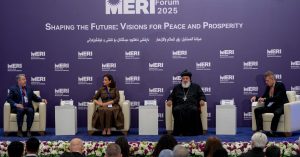
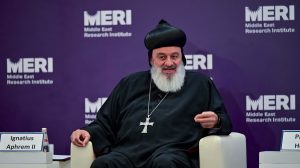
- Ignatius Aphrem II, Syriac Orthodox Patriarch of Antioch and All the East, Syria
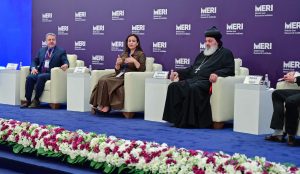
- Najib Ghadbian, Advisor to the Syrian Minister of Foreign Affairs and Expatriates
- Zozan Alloush, DeFacto Dialogue Platform, Syria
- Patrick Haenni, Advisor, Humanitarian Dialogue Centre, Switzerland
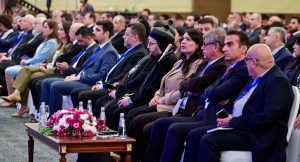
This policy debate assembled three very different Syrian voices- an official advisor to the new Syrian foreign ministry, a Kurdish activist rooted in the North-East’s self-administration, and the Syriac Orthodox Patriarch, moderated by a conflict-resolution practitioner. Framed as Syria ended roughly ten months into a post-Assad transition, the discussion wrestled with how to rebuild the state, manage its diversity, and navigate regional and international dynamics after a long and brutal conflict. What emerged from the debate is a cautious, sometimes fragile, convergence around three pillars: preserving the state while transforming the regime, embracing decentralization as a pragmatic necessity, and investing in a politics of inclusive citizenship and reconciliation rather than sectarian protection.
From “Frozen Conflict” to “Revolutionary” Transition
The moderator, Patrick Haenni, opened up the discussion by contrasting the “depressing” mood of the previous year’s panel, when Syria was viewed as a frozen conflict with no clear horizon, to the current moment, which he described as a “structural revolutionary change”. In his framing, the “revolution” is not merely a protest movement but a literal dismantling of an authoritarian state structure and the attempt to build something new in its place. The fall of the Assad regime was presented as a watershed: Syria is in a “birth phase”, roughly ten months into a new order with a revolutionary military victory in December as the turning point.
From the outset, however, Haenni pointed to an unresolved tension: the military victory of “revolutionary factions” helped in bringing about not only with regime collapse but also, at least partially, the collapse of the state apparatus. The immediate question he posed to Najib Ghadbian is therefore not triumphalist, but institutional: can a revolutionary leadership with limited administrative experience preserve, repair, and re-purpose state institutions rather than preside over their disintegration?
The framing is important. It implicitly rejects two extremes: a nostalgic return to the pre-2011 order and a nihilistic acceptance of state collapse. Yet it also risks underplaying how deeply war, fragmentation, and external interventions have eroded the very foundations of the Syrian state over fourteen years.
Najib Ghadbian, speaking as an academic and long-time opposition figure now advising the new foreign ministry, insisted that what has occurred is a “profound and comprehensive change” whose human and material cost has been immense. He recalled that from the outset many in the opposition were determined to change the regime, not demolish the state, with Iraq’s experience as a cautionary example. In his reading, it was the Assad regime itself that systematically destroyed state institutions and social cohesion, turning Syria into a devastated landscape: close to a million dead, half the population displaced, infrastructure shattered, ninety percent of Syrians below the poverty line, and millions of children deprived of basic rights.
Against this background, he identified security and stability as the new government’s first priority, and he gave the military leadership behind the final phase of change some credit for seeking to minimise bloodshed. He linked the prospects of successful transition to the relative non-violence of the final power shift, arguing that less violent change generally increases the chances of consolidation. This is a reasonable general insight from the comparative literature on transitions, although it perhaps underestimates the depth of earlier violence and the social scars it left behind.
Ghadbian highlighted three immediate security challenges. First, the continuing threat of ISIS, capable of spectacular attacks that can reignite sectarian tensions and undo fragile coexistence. Second, porous borders and the legacy of Syria as a “narco-state”, where the previous regime relied on drug trafficking as a key revenue source. Third, the overarching challenge of building a new state based on citizenship, equality before the law, and a sophisticated management of diversity. Here he acknowledged the difficulty of balancing civil peace with transitional justice. The new authorities have been criticized for prioritizing stable foreign relations over internal accountability, entering into settlements with figures widely perceived as complicit in regime crimes. For many Syrians, such compromises are morally and politically hard to accept.
Here rises a central dilemma: transitions from violent authoritarianism rarely allow a neat sequencing of “security first, justice later”. Delaying justice can poison the legitimacy of new institutions and pursuing it too aggressively can destabilize a fragile order. Ghadbian recognized this, but the panel fell short of offering a clear roadmap for resolving the tension.
North-East Syria, Self-Administration and the Politics of Decentralisation
Zozan Alloush, speaking from the vantage point of North-East Syria and the Kurdish-led experience, began by contesting the moderator’s suggestion that the Syrian Democratic Forces (SDF) did not participate in the “liberation” of Syria. She insisted that the SDF has been central to liberating both North-East Syria from the Assad regime since 2013 and large parts of the country from ISIS, freeing roughly a third of Syria’s territory from “Ba’athist security rule” and jihadist control. She reframes liberation as a deeply collective process: the diaspora lobbying foreign ministries, local communities resisting, and armed factions liberating territory in both the North-West and the road to Damascus.
Turning to negotiations with Damascus, Alloush described a long, difficult process between two sides that have experienced thirteen years of political and social estrangement, layered on top of pre-existing structural marginalization of North-Eastern communities. Despite this, she highlighted a significant positive shift: both Damascus and North-East leaderships now view dialogue as the principal tool for managing conflict and diversity, rather than violence. She presented the March 10 agreement as a historic milestone for North-East Syria and for the Kurdish component, elevating the SDF as a key partner in building a new Syria and enshrining shared principles such as territorial unity.
Her core conceptual contribution was an unapologetic defense of decentralisation as a national solution rather than an ethnic claim. Using both Syrian examples and comparative references (Spain, and implicitly the Kurdistan Region of Iraq), she argued that meaningful decentralisation is the only realistic way to re-integrate a country where each region- the South, North-West, North-East, and coastal areas- has developed its own political and social trajectory. She noted that people who have exercised local powers and developed local institutions for thirteen years will not willingly relinquish them back to a hyper-centralised capital. In her view, a flexible, intelligent decentralised system is the only way to reconcile unity and diversity, proximity and effectiveness in governance.
Here Alloush’s argument was both pragmatic and normative. Pragmatic, because it recognised the de facto fragmentation of authority and sought to channel it into a stable, legally grounded structure; normative, because it linked decentralisation to democratic participation, gender parity in governance, and the substantive inclusion of minorities. She criticised the new electoral process for producing only six women representatives at the national level, arguing that a quota is necessary at this stage to guarantee a minimum level of women’s presence. She also insisted on recognising the Kurdish identity and correcting historical injustices, while refusing a competitive “victimhood Olympics”: all Syrians have suffered, but some were even stripped of their basic legal status as citizens, referring to the Kurds.
Alloush was also relatively optimistic about the international and regional environment. She noted strong support for the negotiation process from the United States, France and other actors, and stressed that Turkey, Iran and Jordan must all be brought into a broader settlement architecture given their border proximity and deep involvement. At the same time, there was a subtle tension between her emphasis on local agency and her acknowledgement that international sponsorship remains necessary for any sustainable settlement.
Diversity, Minorities and the Ethics of Reconciliation
Patriarch Ignatius Aphrem II introduced a different register: that of a religious leader who insists on speaking “not only on behalf of minorities” but as a Syrian concerned with the fate of all his compatriots. He located the Syriac Orthodox community as an ancient, indigenous component of Syrian society, and pushed back gently against the language of “minorities” and “protection”. Christians, he insisted, do not need protection from the outside; their security comes from their Muslim, Jewish (where present) and other neighbours. Syria’s mosaic of Arabs, Kurds, Syriacs, Circassians, Armenians, Sunnis, Alawites, Shi‘a, Druze, Christians, Yazidis and others is a source of richness, not a threat, provided diversity is managed properly.
The Patriarch recognized that under the previous regime there was a certain “management” of diversity which preserved a degree of civil peace, albeit through top-down co-optation rather than genuine inclusion. Christian figures were often appointed for symbolic reasons, without consultation with their communities, and with limited real influence. In the new context, he sees “a genuine opportunity” not only to ensure the survival of small communities on their lands, but to enable deeper interaction and cooperation among all Syrians. He warns, however, that the massive insecurity and economic hardship have generated powerful incentives to emigrate, especially among skilled youth, turning migration into a haemorrhage of human capital.
On the question of external actors, the Patriarch took a cautious but critical line. He welcomed international assistance to the inexperienced new government, but feared that interventions driven by foreign interests rather than Syrian needs could accelerate fragmentation and even lead to partition or chronic internal conflict. He therefore called for a careful balancing act: openness to supportive engagement, coupled with a firm insistence on national priorities.
Perhaps his strongest intervention concernsed reconciliation and forgiveness. Drawing on Christian theology, he argued that Syria urgently needs a nationwide process of reconciliation that includes forgiveness, without erasing the need for justice and accountability. He refers to an initiative he hosted in Damascus that brought together forty-five to fifty representatives from a wide range of communities including Sunnis, Shi‘a, Alawites, Druze, Kurds, Turkmen, Arabs, Syriacs, Armenians, Yazidis and others, many of whom had never previously met. The encounter built new relationships and generated concrete ideas for future cooperation, serving as a microcosm of the broader reconciliation process he would like to see scaled up.
His emphasis on forgiveness was both ethically ambitious and politically contentious. For many victims, calls for forgiveness can feel like pressure to “move on” without proper accountability. The Patriarch was sensitive to this and distinguished between forgiving individuals and abandoning justice; yet the mechanisms he proposed remain under-specified. The analogy to South Africa’s Truth and Reconciliation Commission is suggestive, but Syria’s conflict dynamics, multi-actor, multi-layered, heavily internationalized, may complicate any such model. Still, his insistence that cycles of revenge will doom any new order is a crucial reminder that institutional reform alone cannot heal societies shattered by war.
The Evolution of Islamist Governance and the Question of Legitimacy
Responding to Haenni’s question about the evolution of Hay’at Tahrir al-Sham (HTS) and its leadership, Ghadbian clarified that he spoke as an academic rather than a representative of the group. He sketched HTS’s trajectory: separation from ISIS, rebranding from Jabhat al-Nusra, formal disengagement from al-Qaida, and ultimately a shift towards a more pragmatic, nationally framed project under Ahmad Al-Shaara and his colleagues.
Ghadbian noted that ruling Idlib forced HTS into direct contact with a highly diverse population, including displaced members of all Syrian communities and small Christian and Druze pockets. This experience, he suggested, pushed the movement away from a rigid jihadi-salafi ideology towards a more pragmatic, “civilian” mode of governance and a discourse focused on building a modern civil state for all citizens. He emphasized that this evolution remains contested, including within Al-Shaar’s own circles, where elements are likely uncomfortable with the de-ideologisation and nationalisation of the project.
Here, too, there was a tension between description and prescription. On one hand, Ghadbian’s analysis acknowledges real ideological and organisational shifts within HTS; on the other, it risks underplaying the extent to which power structures and coercive apparatuses may remain shaped by the group’s militant origins. The panel did not delve into questions such as human rights practices in Idlib, the nature of political pluralism under HTS, or the group’s long-term relationship with other Syrian actors. Yet the broader point stands: any inclusive national project will have to grapple with actors whose pasts are deeply problematic but whose current behaviour and positions are evolving.
Constitutional Design, Political Participation and Gender
In the latter part of the discussion, the focus shifted explicitly to the design of the transitional framework: the constitutional declaration, the national dialogue process, elections, and transitional justice. Alloush returned to the question of why Syrians rose up in the first place, stressing that it was not primarily about bread and basic services, but about a structural political problem: the exclusion of citizens, parties and social components from meaningful participation in running the state. She argues that any conversation about stability, security and non-repetition of atrocities must go back to this core political deficit.
For her, a five-year constitutional declaration can be an acceptable transitional arrangement, but only if it guarantees clarity on the system of governance, the nature of citizenship, and the rights of various components, not only ethnic ones, but political and social currents. She demanded the right, as a Kurdish Syrian citizen, to know how the state will deal with dissenting projects and alternative visions, and insisted that decentralisation be embedded as a general principle of development and administration rather than treated as a Kurdish “special request”.
She also highlighted the need to rename and reframe the republic in a way that encompasses all components while making clear that recognising Kurdish identity does not imply denying Arab culture or language. Her critique of the recent elections as virtually excluding women from meaningful representation reinforced her broader thesis: without deliberate measures (such as quotas for women) in this transitional period, the structures of exclusion will simply reproduce themselves under new names.
These arguments exposed a recurring contradiction in many post-authoritarian settings: the temptation to treat “technical” constitutional fixes as sufficient, without addressing the underlying habits of centralisation, patriarchal dominance and majoritarianism. Alloush’s interventions challenged this by tying institutional design to lived experiences and power relations.
Regional and International Repositioning
In response to Haenni’s final question on why Syria has so far avoided a classic “counter-revolutionary” regional backlash, Ghadbian explained that the new leadership has consciously sought to differentiate itself from earlier Islamist-led transitions in the region. The objective has been to present a religiously rooted but politically moderate and regionally acceptable project, rather than a polarising Islamist agenda that would trigger fierce opposition from neighbouring regimes.
He described a foreign policy prioritising the shedding of Syria’s previous role as a source of instability for its neighbours, including ending the export of weapons, militias and narcotics. This repositioning, coupled with a strong focus on lifting sanctions and attracting reconstruction investment, helped open doors in the region. Support and facilitation from Saudi Arabia, Qatar, Turkey and others enabled high-level contacts, including a notable meeting between Ahmad Al-Shaara and U.S. President Donald Trump, which Ghadbian presented as an unusual but advantageous endorsement.
At the same time, he noted that the new authorities wish to maintain channels with Russia and to eventually normalise relations with Iran, despite the latter being perceived as a relative loser in the new regional configuration. Relations with Israel remain deeply problematic, especially given repeated airstrikes and attempts to interfere in Syria’s southern regions, yet the government seeks to avoid war and focus on domestic reconstruction. The overarching aim is to reposition Syria as a factor of stability, connectivity and cultural exchange rather than a theatre of proxy conflict.
This foreign policy vision, while ambitious, may face significant constraints: lingering mistrust among regional actors, unresolved territorial disputes, overlapping security concerns, and unstable internal landscape. Nevertheless, it reflects a deliberate attempt to break with the previous regime’s transactional and often destabilising regional role.
Convergence, Fault Lines and Prospects
Despite the profound differences in background and emphasis, the panel ended on a relatively hopeful note. Haenni observed that, compared to the previous year, there appeared now no fundamental disagreement on the broad headings of a political solution: decentralisation is widely accepted as a principle, dialogue is acknowledged as indispensable, and the language of inclusive citizenship has become a common reference. The real struggles and the devil, as he noted, lie in the details and implementation rather than in the general headings.
The discussion, however, also revealed fault lines that will shape Syria’s trajectory. The tension between civil peace and transitional justice remains unresolved. The extent and shape of decentralisation are still contested, even if the label is widely accepted. The place of religion in public life and constitutional identity continues to generate anxieties among both minorities and segments of the majority. And the presence of powerful external actors, even when framed as supportive, will inevitably interact with internal divisions in unpredictable ways.
Yet there was a shared recognition that returning to authoritarian centralism was neither possible nor desirable, that Syria’s diversity remained an asset if managed wisely, and that reconciliation, however difficult, was essential to prevent the past fourteen years from hardening into permanent fragmentation. The panel closed with a modest, “cautious optimism” compared to the despair of the previous year: a fragile but real opening to imagine a Syria that is united without being uniform, decentralised without being dismembered, and rooted in a citizenship that is more than a legal fiction.
MERI Forum 2025
In Search of Unity Amidst Fragmentation
***
About MERI:
The Middle East Research Institute (MERI) is internationally ranked as Iraq’s leading think tank and policy research institute. As an independent, non-profit, grant-funded organisation, MERI advances evidence-based policymaking, democratic governance, and sustainable development through research, policy analysis, dialogue, and public engagement.
MERI’s research focuses on Iraq, the Levant and the wider Middle East, covering governance, state-building, foreign policy, regional security, post-conflict recovery, violent extremism, displacement, minority rights, women’s rights, civil society, Baghdad–Erbil relations, and broader geopolitical developments. Through its publications, policy dialogues, and the annual MERI Forum, MERI brings together policymakers, diplomats, academics, and civil society leaders to promote informed debate and practical policy solutions for the region’s most pressing challenges.