


- Said Al-Masri, Arab Thought Forum, Jordan
- Ammar Kahf, Director, Omran Center for Strategic Studies
- Makram Ouaiss, Director, The Lebanese Center for Policy Studies
- Sherwan Yousif, Director, DeFacto Dialogue Platform, Syria
- Edmund Ratka, Konrad Adenaur Stiftung (Moderator)
The Policy Debate “The Levant Beyond Conflict: Strategies for Recovery and Reintegration” brought together expert voices from Jordan, Lebanon and Syria to reflect on how a region scarred by war, displacement and external interference might move toward a more cooperative, rules-based future. While the speakers differed in emphasis, a common thread ran through the conversation: recovery in the Levant cannot be achieved by each state acting alone, nor can it be imposed from outside. It requires a combination of internal reform, regional reconciliation, and carefully designed frameworks for cross-border economic and social cooperation in which local actors regain agency over their own future.
The moderator, Edmund Ratka, framed the discussion by contrasting the region’s current “horrible moment of conflict,” especially in Gaza, with the longer-term need to “unleash its full potential.” Borrowing from European integration debates, he repeatedly returned to the idea that “form follows function”: instead of grand, rigid regional blueprints, the Levant may need flexible, function-based cooperation, starting where there are concrete needs and mutual interests, then building structures around them.
Jordan’s Proposal: A Levant–Iraq–Arabian Peninsula Economic Block Anchored in Reconciliation
From Jordan, Said al-Masri offered a broad diagnosis of regional fragility and a bold, if ambitious, proposal for moving forward. He linked Jordan’s own economic stagnation, low growth rates around 2–2.5%, rising debt and unemployment, to global “international anarchy”: tariff wars, sanctions, and a weakened multilateral trade system. Jordan remains politically stable, he stressed, but that stability is under constant pressure from economic underperformance and regional shocks.
Al-Masri situated Jordan within a troubled neighborhood: a Syria fragmented by “diversified foreign hegemony,” trying to hold together a mosaic of communities under external pressure; an Iraq with electoral turnover but continuing “armed factions” that share in decision-making; a Lebanon with a “paralyzed system”; and Palestinian territories facing cantonisation in the West Bank and devastation in Gaza. Across this picture, he described societies as “traumatized communities” that need both psychological and institutional repair.
His core proposal was the Levant and Iraq Forum, recently launched in Amman, which he described as a “skeleton” with an organisational chart and terms of reference that could underpin a hierarchical system for dialogue, reconciliation and policy coordination among Levantine states and Iraq. This, in his view, is not an abstract exercise: it is a tool to begin “remedying our social diseases” and to embed reconciliation in regional structures.
Crucially, he insisted that reconciliation must be accompanied by “dividends for peace.” People must feel that peace pays. This requires moving the economies of Iraq, Syria, Jordan, Lebanon and Palestine together, rather than each country struggling separately. Drawing on the post-war European experience, he suggested that the region should pursue its own version of an economic block, not only Levant and Iraq but also the Arabian Peninsula, forming a comprehensive market. The European Union, he argued, could play the role of catalyst by offering incentives and helping design mechanisms, just as European integration began with concrete sectors like coal and steel.
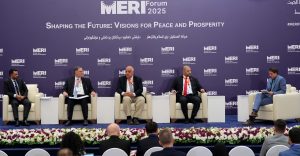
In his later intervention, Al-Masri deepened the focus on demographic and security pressures. He underlined that the economic crises in the region make large-scale displacement and refugee inflows especially destabilising, stressing that demographic change is “a catastrophe” regardless of its origin, because it strains social cohesion and economic capacity. Using Jordan as an example, he insisted that Amman’s national consensus is to refuse any forced transfer of West Bank Palestinians into Jordan or anywhere else, framing this as essential to protecting both Jordan and Palestine.
For him, security is the first priority of any crisis response: robust, professional security institutions, can hold societies together even under severe economic stress. But he concluded that the region must already be “thinking about the future” and preparing for better conditions, so that when political openings come, regional actors are ready to rebuild together and to rehabilitate populations traumatised by years of war.
This vision is deliberately expansive. It seeks to marry security, reconciliation and economic integration in one regional project, with the EU as an anchor. The ambition is significant, and the obstacles, ranging from divergent regimes to external rivalries and weak regional institutions, are considerable. Nonetheless, Al-Masri’s arguments highlight two important points: the centrality of reconciliation as a mindset, not just a policy; and the need to think of recovery as a shared regional endeavor rather than a series of isolated national struggles.
Lebanon’s Perspective: Stability, Governance, Refugees and the Role of the Diaspora
From Lebanon, Makram Ouais painted a picture of a state trapped between internal paralysis and external shocks, yet still holding on to the aspiration of regional integration. Since 2019, Lebanon has been beleaguered by a severe economic collapse, following the impact of the Syrian conflict and long-standing governance weaknesses. Hopes of serving as a hub for trade routes and regional collaboration have repeatedly been thwarted, partly because of domestic divisions and partly due to “repeated aggression from the outside.”
Looking ahead, Ouais identified several preconditions for Lebanon, and the region, to move toward recovery and integration. The first is stability: most countries in the region are either in conflict or “teetering on the edge,” an environment that is “not a recipe” for attracting capital, encouraging expatriates to return, or fostering genuine collaboration. The second is internal agreement and self-reliance: instead of depending on external funding and agendas, societies need to fund themselves and build mechanisms for genuine internal dialogue, improved governance and stronger state institutions.
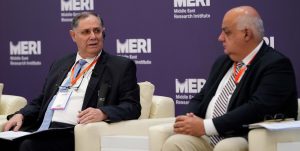
He also stressed the importance of addressing unresolved legacies between states and within societies. These include “dealing with the past” in a conflict-resolution sense: clarifying the fate of the missing and disappeared, addressing refugee and IDP issues, and reducing tensions around large displaced communities. With refugees now representing roughly one in four residents in Lebanon, and similar pressures in Jordan and Syria, unresolved displacement is both a humanitarian problem and a structural constraint on stability. For Ouais, managing IDPs, refugees and return is inseparable from reconciliation and governance reform.
In a more forward-looking spirit, he advanced two concrete cooperation ideas. The first is an intergovernmental working team, ideally multilateral, that would tackle “pending issues that are still problematic between the states in the region,” such as cross-border disputes, security files and displacement. Starting small, this mechanism could gradually expand to involve the most affected countries and build habits of structured dialogue on shared problems.
The second is academic and social: significantly expanding student exchanges across the region, not only in technical fields like medicine and engineering but especially in political science, sociology and governance. Wars have built “walls between the different countries,” he observed; apart from those who move as refugees, ordinary citizens rarely interact across borders in meaningful ways. Encouraging young people to study, live and work in neighboring countries could help rebuild trust and familiarity, much as the Erasmus programme did in Europe.
Later in the discussion, Ouais highlighted the double-edged role of the Lebanese diaspora. On one hand, remittances now provide roughly one-third of Lebanon’s GDP, cushioning the impact of the economic collapse. On the other, the “brain drain” of talented, reform-minded youth is a major loss. Many would “love to come back and invest,” but will not do so until conditions of security, governance, and the rule of law, improve. Without such changes, diaspora support will remain limited and cautious, “help from afar” rather than full re-engagement.
On internal displacement, he stressed that returns are closely tied to reconciliation: people do not go back if they are afraid, and governments may not facilitate returns in the absence of genuine local settlement. Lebanon’s own experience since the civil war shows that unresolved grievances can make some displacement effectively permanent for certain communities. Here, Ouais implicitly offered Lebanon as a case from which Syria and others might draw lessons, both on the risks of unresolved displacement and on the need for structured reconciliation mechanisms alongside economic reconstruction.
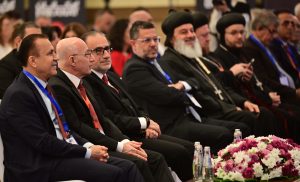
Syria’s Internal Debate: Governance, Identity and the Need for Inclusive Local Structures
Syrian perspectives were represented by two voices, Sherwan Yousif and Ammar Kahf, who both stressed that the country is undergoing a profound, uncertain re-negotiation of its identity, governance formula and regional role.
Sherwan Yousif described a society living in a state of “uncertainty” about its future: people across Syria are asking what the new government wants, what will happen in Suwayda, what the fate of Kurds and other communities will be, whether there are guarantees against new massacres, and what the overall shape of governance and national identity will be. The positive element, in his view, is that the fall of the previous regime has changed the terms of debate: Syrians are now discussing options and models of internal governance, rather than living under a security-dominated state that censored such questions.
He traced many current challenges, whether faced by Kurds, Alawites, Druze, other minorities, or civil society, back to a single root cause: a centralised, security-heavy regime that dominated all aspects of life, hosted disruptive armed groups that troubled its neighbors, and engaged in alliances at odds with internal interests. Syria, he argued, had become a “source of annoyance” for the region. The task now is to design a new system that turns Syria into a source of stability for its neighbors rather than a vector of violence, weapons and narcotics.
For Yousif, this requires a re-imagined internal governance model that is participatory and decentralised. International frameworks such as UN Security Council Resolution 2254, local agreements like the 10 March understanding between the Syrian Democratic Forces (SDF) and the Syrian government, and ongoing debates on local administration, all represent, in his words, “opportunities” and “guarantees” that can anchor a new order, especially after the atrocities that have occurred in various parts of the country. A key condition, he argued, is that international openness to the new government in Damascus should be conditional on good governance while also understood as encouragement to prove that Syria can be a place of stability rather than a regional spoiler. That proof must come through inclusive governance, protection of minority rights, and shared decision-making at the local level, not via a return to rigid centralisation.
When asked later about practical cooperation ideas, Yousif argued that before development projects or cross-border initiatives can flourish, there must be a change in the “climate” between neighboring societies. The diverse identities of the Levant, ethnic, religious, cultural, have often been turned into sources of hostility rather than strength. To reverse this, he suggested starting with track two dialogue among civil society organizations and think tanks across borders, creating spaces where new narratives can emerge that move beyond “classic nationalist narratives, religious fanaticism, and regressive ideologies.”
He also underlined the potential of “flexible cross-border economies” and shared educational curricula that reduce gaps in mutual understanding. But he returned repeatedly to the need for long-term, multi-level dialogue, especially on security relations so that “security” is not used as a pretext for conspiracy and mutual suspicion. Only in such a climate, he argued, will Syrians be able to travel to Iraq, Jordan or Lebanon for tourism, learning and business rather than fleeing massacres and economic desperation.

Syria as a Hub: Interconnectivity, Refugee Return and a Regional Pact against Hate
Ammar Kahf approached the Syrian file from a more overtly geopolitical angle, linking internal change to regional interconnectivity and the design of a new Levantine order. He recalled that at the previous Levant and Iraq Forum, speakers warned of an “illusion of stability” and “frozen conflict” across the region, situations that looked calm from a distance but could explode at any time, leading to “lose–lose” scenarios. One school of thought, he noted, had advocated “adapting to a long-term low-intensity conflict,” as if instability were a permanent condition.
In his reading, the recent evolution in Syria has created a new moment. One party has effectively “taken over power,” sidelining the Geneva/2254 middle-ground process and creating a different set of realities on the ground. Kahf interpreted this not only as a setback for a negotiated transition, but also as a potential “opportunity” to reposition Syria as a hub of regional interconnectivity, provided it no longer serves as a conduit for weapons, Captagon or militias, and instead focuses on trade, infrastructure and cooperative security.
He argued that the removal of most Iranian militias from Syrian territory has already changed the regional “non-order,” opening space for healthier relations with neighbors and global powers alike. In this context, he sees prospects for pipelines linking Iraq to the Mediterranean via Syria, increased trade, and the engagement of Jordanian, Turkish, Lebanese, Egyptian and Iraqi companies in reconstruction and infrastructure. For him, these concrete projects are the physical expression of interconnectivity that can underpin a new “Levant and Iraq agreement,” possibly modeled, in part, on European neighborhood frameworks.
Kahf also laid out a multi-layered cooperation agenda. At the strategic level, he emphasised education as a long-term investment, calling for scholarship programmes and student exchanges under the Levant & Iraq Forum to train the next generation of diplomats and policy thinkers across Syria, Jordan, Lebanon, Palestine and Iraq. In the short-term, he focused on three domains:
- Refugee return: He advocated a regional framework for voluntary, dignified refugee return, arguing that current conversations are happening “in solo” rather than coordinated fashion. Such a framework would involve Syria, Iraq, Jordan and Lebanon, and would address legal conditions, security guarantees and practical arrangements for return.
- Local governance twinning: Many areas in the region lack strong institutions and administrative capacity. By “twinning” local governments across borders, sharing experiences, training staff, and harmonising some practices, countries can support each other’s institutional growth rather than leaving weaker localities isolated.
- Hate speech and anti-discrimination: He proposed a regional initiative to counter hate speech and promote anti-discrimination laws, arguing that the region’s societies are “very emotional” and highly influenced by social media. Positive, coordinated messaging by religious, communal and political leaders, as well as shared symbols and cultural products, could help reduce tensions.
In the Q&A, he expanded on the idea of reconciliation “without forgetting.” Syrians and their neighbors, he suggested, may need to “forgive but not forget”: to build national memories and symbols that deter future dictators and signal that crimes will be held accountable, while still creating space to move forward. A “Damascene pact” alone is not enough; rather, a cross-regional pact protecting equal citizenship and the rights of all components is needed, given how intertwined the region’s narratives are.
Kahf also addressed the question of “spoilers” and “conveners” in any Levantine project. He identified Israel’s recent military actions and Iran’s policies (including cyber operations and support for proxies) as major destabilising factors, and mentioned Qatar among recent complicating actors. As for conveners, he argued that actors such as Syrians, Iraqis, Jordanians, Lebanese and Palestinians, must be at the center, pursuing balanced relations with larger powers such as the United States, Russia, China and India without turning the region into a battleground for their rivalries.
Displacement, Demography and the Centrality of Security and Reconciliation
Audience interventions and responses brought the discussion back to one of the region’s most pressing cross-border challenges: displacement. A participant noted that Iraq and Syria have been “the epicenter of troubles,” with large numbers of disabled people and displaced populations, and complained that when political parties take power, displacement often becomes “the last point in their mind,” when it should be the first. Another questioner highlighted recent massacres in Suwayda and Latakia, asking what guarantees exist that similar atrocities will not recur in Kurdish neighborhoods of Aleppo such as Sheikh Maqsud.
These concerns prompted more detailed reflections from the panel. Kahf acknowledged the real risk of inter-communal violence, but pointed to recent de-escalation in Sheikh Maqsud as a sign that political leadership can sometimes resist spirals of revenge. He returned to the need for a regional culture of equal citizenship and legal frameworks against discrimination that would give communities more confidence in their safety.
Ouais reiterated that internally displaced persons do not simply return once fighting stops; they need security, reconciliation and often concrete guarantees. Without these, displacement risks becoming semi-permanent, as Lebanon’s own history shows.
Al-Masri stressed again that demographic engineering through forced displacement is a “disaster” in any form. He warned that in economically strained societies, large inflows of refugees or IDPs can exacerbate tensions and distort demographic balances, even when there is sympathy for those fleeing conflict. Jordan’s firm opposition to any forced transfer from the West Bank to Jordan, he argued, is not hostility to Palestinians but a defense of both Jordan’s and Palestine’s viability.
In this context, the panel’s recurring emphasis on security is significant. Several speakers, especially Al-Masri, treated effective security institutions as a prerequisite for everything else, economic development, reconciliation and refugee return. At the same time, Yousif and Kahf cautioned that “security” must be reimagined: it should not be the tool of one group against others, nor an excuse for repression, but part of a broader framework that includes inclusive governance, rights protections and cross-border cooperation.
Conveners, Culture, and the Question of Local Agency
The panel closed with a return to the question of who will drive Levantine recovery. Ratka asked which actors might serve as conveners and which as spoilers in any emerging regional framework. Kahf responded by underscoring the importance of “local agency”: Levantine societies must reclaim the initiative rather than waiting for external powers to design their future. Regional states, he suggested, are already experimenting with more balanced foreign policies, maintaining relationships with Washington, Moscow, Beijing and others without fully aligning with any camp. This diplomatic diversification, if anchored in local cooperation, could support a more autonomous regional order.
In his final remarks, Ratka reflected that, despite expectations that the session would focus primarily on infrastructure, the conversation had centered more on culture, narratives, education and reconciliation. Quoting Jean Monnet, one of the architects of European integration, he recalled that if Monnet could start again, he would “start with culture” rather than coal and steel. The panel’s emphasis on student exchanges, joint curricula, inclusive narratives and social dialogue suggests that some of the region’s practitioners may share that instinct.
Conclusion
This panel offered a textured, forward-looking discussion of how the Levant might move beyond conflict toward recovery and reintegration. Participants converged on several key themes:
- Recovery requires regional, not just national, solutions. Displacement, security, trade, and environmental and demographic challenges spill across borders and cannot be addressed in isolation.
- Internal reform and governance are indispensable. Without more inclusive, accountable and effective institutions, neither refugees nor diaspora communities are likely to return in large numbers, and external support will remain limited.
- Reconciliation and “dealing with the past” are not optional add-ons, but core elements of any sustainable settlement. They are directly linked to the prospects of safe return, social cohesion and long-term stability.
- Economic integration and interconnectivity—through markets, pipelines, trade corridors and flexible cross-border economies—can provide the “dividends for peace” that make reconciliation tangible for ordinary people.
- Education, culture and youth exchanges may be slow-burn investments, but they are central to changing mindsets, breaking down walls between societies, and forming a new generation capable of cooperative politics.
The proposals on the table, from a Levant–Iraq–Arabian Peninsula market with EU support, to regional frameworks for refugee return, to intergovernmental working teams and local governance twinning, are ambitious and will face serious political and practical obstacles. Yet the conversation itself is informative. Instead of treating the Levant as simply an arena for great-power competition or a string of isolated crises, the panelists treated it as a shared political space in which local actors can and must define their own agenda. In that sense, the most important takeaway may be less any specific proposal than the insistence that a more cooperative, rules-based regional order is thinkable and that its building blocks already exist in the ideas, networks and institutions the participants were trying to stitch together.
MERI Forum 2025
The Levant Beyond Conflict: Pathways to Recovery, Integration, and Local Agency
***
About MERI:
The Middle East Research Institute (MERI) is internationally ranked as Iraq’s leading think tank and policy research institute. As an independent, non-profit, grant-funded organisation, MERI advances evidence-based policymaking, democratic governance, and sustainable development through research, policy analysis, dialogue, and public engagement.
MERI’s research focuses on Iraq, the Levant and the wider Middle East, covering governance, state-building, foreign policy, regional security, post-conflict recovery, violent extremism, displacement, minority rights, women’s rights, civil society, Baghdad–Erbil relations, and broader geopolitical developments. Through its publications, policy dialogues, and the annual MERI Forum, MERI brings together policymakers, diplomats, academics, and civil society leaders to promote informed debate and practical policy solutions for the region’s most pressing challenges.