


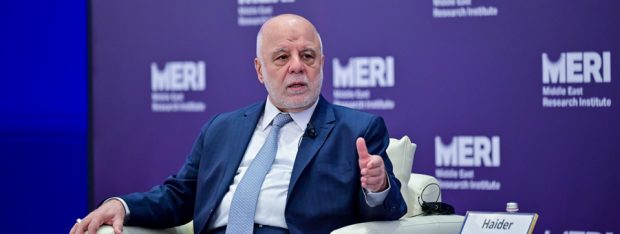
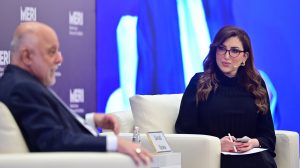
- Haider Al-Abadi, Former Prime Minister of Iraq & Leader of Al-Nasr Alliance
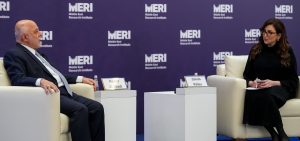
- Zainab Rabea, Al-Sharqiya News Anchor (Moderator)
Introduction: Elections, State-Building and a Fragile Equilibrium
This panel brought former Iraqi Prime Minister and leader of the Al-Nasr Alliance, Dr. Haider Al-Abadi, in conversation with Zainab Rabea, Al-Sharqiya news anchor, to reflect on the challenges of state-building in Iraq’s contentious political environment. Against the backdrop of the upcoming 2025 elections, enduring questions over the integrity of the electoral process, the nature of governance, and the role of external actors shaped the dialogue. The discussion oscillated between immediate electoral concerns and deeper structural issues: justice and inequality, sectarianism and identity, the legacy of Baathism, and the unresolved tension between religion, law and democratic pluralism.
From the outset, Zainab anchored the conversation in the political moment: the intensifying electoral climate, the recent visit of al-Abadi to Erbil and his meetings with Kurdish leaders, and the broader question of how the Kurdish political establishment views the upcoming elections.
Electoral Politics: Between Constitutional Duty and “Distorted” Practice
Al-Abadi began by reaffirming elections as a constitutional obligation, insisting that they must proceed within the prescribed timelines regardless of the level of enthusiasm or skepticism among political actors. He described a clear readiness for elections in both Erbil and Sulaymaniyah, but underlined a deep undercurrent of anxiety: political elites and citizens alike are asking “what will happen?” and “what results should we expect?” This uncertainty, he argued, is compounded by pervasive fears of electoral manipulation.
In his view, tampering with the electoral process poses an existential threat to Iraq’s democratic experiment. The country’s pride in peaceful transfers of power, whereby former prime ministers and ministers remain free and engaged in public life, rests on the credibility of elections. If this trust is undermined by fraud, vote-buying and the abuse of state resources, the entire democratic edifice will be weakened or lost. Al-Abadi was particularly critical of the explosion of political money in this electoral cycle, speaking of campaign spending that has “exceeded imagination” and widespread vote buying that far surpasses previous practices. For him, this is not democracy but a distortion that must be corrected.
As a form of protest against these distortions, al-Abadi stated that he deliberately refrained from presenting candidates in this cycle, not because he opposes elections, but because he refuses to be part of a “distorted process.” He remains within a broader electoral alliance, yet insists on recording a clear objection to the current methods, especially the use of money and influence that erode public trust.
Baghdad–Erbil Relations and the Federal Vision
Despite his concerns about elections, Al-Abadi expressed cautious optimism about the state of relations between Baghdad and Erbil, especially after the recent oil agreement that allows the federal government to pay salaries in the Kurdistan Region within the framework of the national budget and SOMO exports. He framed this as a success for all: citizens in the Kurdistan Region, Iraqis more broadly, and both federal and regional authorities.
More fundamentally, he reiterated his belief in a federal, decentralized Iraq. For him, decentralization is not a “gift” granted by the centre, but a constitutional and functional necessity. Different regions and governorates have distinct needs and characteristics that cannot be managed efficiently through centralization alone. The key, he argued, is to ensure that devolved powers operate within constitutional frameworks and sound mechanisms, rather than ad-hoc or politicized arrangements. Yet he acknowledged that the gap between rhetoric and reality persists: persistent delays in passing core legislation, such as the oil and gas law, illustrate how unresolved structural issues continue to burden centre–periphery relations.
Fragile Gains: Security, Relative Prosperity and the Risk of Regression
Reflecting on the broader trajectory since 2003, al-Abadi contrasted the present moment with earlier phases of severe insecurity. He recalled the years 2006–2007, when moving between the Karkh and Rusafa sides of Baghdad was dangerous due to terrorist violence emanating from the sectarian war. He also recounted the later existential threat posed by ISIS, which controlled vast territories and put the very existence of Iraq in question. In comparison, today’s Iraq is relatively secure, and there is visible economic activity: streets and markets are full, and a certain level of consumer spending suggests relative prosperity.
However, he was clear that these gains are fragile. The central question, he argued, is not whether a degree of security and economic life exists today, but whether Iraq can sustain and deepen these gains. If not, he warned, the country risks sliding once again into crisis. For Al-Abadi, the looming danger lies less in the absence of resources and more in the absence of justice and fairness in how those resources are managed and distributed.
Justice, Inequality and the Politics of Distribution
Zainab challenged the notion of “prosperity” by pointing to official poverty statistics from the Ministry of Planning, highlighting the existence of a large impoverished segment of the population. Al-Abadi agreed, defining the core problem as one of justice. Citizens, he argued, can be patient when the state simply lacks resources, but they cannot accept blatant inequity in the distribution of jobs, opportunities and wealth.
He illustrated this with an anecdote about a fellow prime minister who promised government jobs to a group of demonstrators outside the Green Zone: four hundred and fifty individuals who had the means to reach Baghdad were granted positions, while countless others in distant villages had no such access or visibility. This, he insisted, is not justice. Massive hiring campaigns, such as the appointment of nearly one million employees over two years, may temporarily appease demands, but they create new layers of unfairness in the future: new graduates ask why their peers were hired while they are left without opportunities, even though they are equally Iraqi.
Al-Abadi also highlighted the importance of equality in wealth distribution. In some families, five or six members may be employed in the public sector, while entire families or even tribes may have no one in a state job. Given that around 95 percent of Iraq’s revenues come from oil, no group can legitimately claim these resources as their private domain. The result, he warned, is a landscape where some enjoy unimaginable wealth while others struggle to secure basic needs. Such injustice, in his view, is a recipe for revolt, and revolutions that “do not distinguish between the good and the bad”; if a revolution occurs, everything collapses.
National Identity, Governance and the Limits of Majoritarianism
The conversation then shifted to the impact of elections on national identity and the emergence or absence of a unifying Iraqi civic identity after more than two decades of political change. Al-Abadi argued that Iraq’s governance landscape is plural and fragmented; no single actor can credibly claim exclusive control over the state, particularly in Baghdad. Power is distributed among the executive, parliament and the judiciary, and each domain has its own performance issues and accountability gaps.
He questioned whether the political system has, in fact, produced better governance and improved representation after each electoral cycle. Instead of resolving disputes, elections have often triggered new crises. The 2021 elections, for example, led to severe political conflict and even armed clashes inside the Green Zone, something that did not occur even during the most intense years of terrorist attacks. Elections, he insisted, should settle matters, not ignite further conflict.
Al-Abadi was skeptical of simplistic majority–minority models in Iraq’s context. In societies where parties are cross-sectarian and programmatic, majoritarian rule can function with stable alternations of power. In Iraq, however, sectarian and ethnic alignments make exclusionary rule dangerous: a majority government that completely sidelines the minority risks provoking mass unrest. His “strategic solution” lies in forming a genuinely cross-sectarian political bloc that transcends identity divisions and focuses on citizens’ concrete needs: employment, dignified living, quality education and health services. So far, he lamented, Iraq has not succeeded in building such a bloc.
Sectarianism, External Alignments and the Battle over Narratives
Zainab drew attention to another dimension of identity politics: Iraqi politicians who appear more loyal to regional powers than to Iraq itself, sometimes speaking as if they were “more Iranian than Iran” or “more Turkish than Turkey,” with supporters waving foreign flags even at national events. Al-Abadi replied that ordinary citizens have become more aware and more resistant to sectarian and divisive rhetoric than some politicians. He recalled the peak of sectarian polarization in 2006, when politicians from opposing camps mobilised their bases through inflammatory media discourse, even while maintaining friendly relations among themselves in parliament. This, he argued, is deeply dangerous, as it divides society and ultimately leads to bloodshed.
He cautioned against recurring media waves that incite people along sectarian, ethnic or regional lines, emphasizing that administrative divisions should serve development, not fragmentation. For him, Iraq possesses many factors of success, yet political actors often focus on failure, undermining their own system in the process. He urged political leaders to understand that their interests can be better served within a stable, lawful system that guarantees economic benefits through legitimate means, rather than through a zero-sum scramble over spoils. The essential shift, he said, is to move from a mentality of “what is mine and what is yours” to a mentality of “what belongs to the homeland.”
On ‘Shia Rule’ and Religious Legislation: Citizenship versus Hegemony
One of the more sensitive parts of the discussion addressed the concept of ‘Shia rule’ or sectarian hegemony in a multi-ethnic, multi-religious country. Al-Abadi categorically rejected the idea that any sect, ethnicity or religion should claim “hakimiyya” (sovereignty or supremacy) over others. In purely theological terms, he said, sovereignty belongs to God alone, and no one can credibly claim to represent God on earth in a way that grants them political supremacy. Whether framed as Sunni, Shia or Kurdish dominance, such claims are, in his view, illegitimate in a diverse society.
In democratic systems, he conceded, the majority chooses the government, but this does not grant the majority the right to trample on the fundamental rights of minorities. The majority may govern, but it cannot persecute or dispossess others. For him, the state is responsible for managing the collective interests of all citizens, without discrimination.
When Zainab noted that many laws in Iraq are drafted in accordance with Islamic sharia, and that religion is a foundational element of the state, Al-Abadi distinguished between two issues: personal conviction and public coercion. In matters such as personal status, he argued, individuals should be free to follow the religious framework they believe brings them closer to God. Just as in European systems individuals can structure their inheritance through wills as they choose, Iraqi citizens who adhere to a particular jurisprudential tradition should be allowed to voluntarily subject themselves to it. His objection was not to the existence of religiously inspired options in personal status laws, but to the way some laws were passed through “deals” and opaque procedures. If the content is correct, he argued, there should be no need for secretive bargains; laws ought to pass through transparent, proper legislative channels.
The Baathist Legacy: Authoritarian Temptations and Transitional Justice
The discussion then turned to the legacy of the Baath regime and the anecdotal phenomenon of young Iraqis raising Baathist slogans or images of Saddam Hussein. Al-Abadi traced the contrast between Iraq’s earlier decades, when the country was ahead of its regional peers in education, health, services and culture, and the post-2003 period, in which Iraq has fallen behind many neighbors on multiple fronts. He rejected any suggestion that the former regime was “successful,” reminding the audience of mass graves, chemical attacks on citizens, and the monopolization of power and wealth by a narrow elite. Even mafia organizations, he said, would not sink to some of the practices of the old regime.
At the same time, he acknowledged that some of those brandishing Baathist symbols today may be driven less by genuine nostalgia and more by anger at the current political class; they seek to “provoke” the present rulers and express their dissatisfaction. Nonetheless, he described Baathism as “dangerous and conspiratorial,” noting that he has never heard a Baathist publicly apologies for the crimes of the regime. Without accountability, former adherents remain ideologically conditioned, capable of committing new crimes while believing they are doing good.
He was also critical of the way de-Baathification and accountability mechanisms have been used in post-2003 Iraq. Originally part of transitional justice, these tools were meant to be temporary. However, their politicized application to eliminate rivals or reward allies has, in his view, undermined their legitimacy and contributed to a distorted political environment.
Moreover, he warned that the “Baathist disease” is not confined to former regime members. The authoritarian impulse, the desire to be an unquestioned leader surrounded by loyal followers, is a recurring temptation among some contemporary politicians. He argued that this culture must be resisted; Iraq must avoid reproducing a new Baath in different packaging. Today, he noted, at least the government is widely criticized and journalists can openly challenge power, which marks a significant difference from the totalizing repression of the past. Yet harassment, vexatious lawsuits and pressure on journalists and activists persist, and must be confronted if Iraq is to consolidate a democratic state rather than slide into a subtler form of authoritarianism.
Freedoms, Institutions and the Crisis of Participation
Zainab pointed to various forms of pressure on activists, journalists and ordinary citizens under pretext of combating Baathism. Al-Abadi distinguished between systemic repression from the top, as under the former regime, and the current situation, where specific individuals or factions within the state may engage in abuses, but others within the system oppose such practices. The task, he argued, is to refuse any encroachment on public freedoms and citizens’ rights, under any pretext. If violations are tolerated against some, the damage will eventually reach everyone.
He stressed that strengthening state institutions is the key to protecting both citizens and the political process. When institutions are strong, he argued, all become stronger, including political forces; when institutions are weakened in favor of parties or individuals, the entire system becomes fragile and dangerous. Restoring public trust requires making the state appear as a reliable, impartial guarantor of rights and services.
Turning back to the electoral arena, Al-Abadi recognized a serious crisis of participation and confidence. A substantial proportion of eligible voters have not even obtained electoral cards, and among those who have, roughly half do not vote. Even if the constitution does not require a minimum turnout for elections to be considered valid, the question remains whether a government chosen by only a small fraction of citizens can truly be seen as representative. Expanding the electoral base, especially by encouraging critics and opponents to participate, is essential if the system is to enjoy meaningful legitimacy. The idea of “punitive voting,” whereby citizens vote for the least bad option to block corrupt candidates, is one mechanism through which disenchanted voters might re-enter the process.
Regional Dynamics, Iranian Influence and Iraqi Sovereignty
Finally, the conversation touched on regional dynamics, particularly the role of Iran amidst renewed sanctions (‘snapback’) and pressure from Western actors, including the United States and Israel. Zainab asked whether Iran’s ability to shape Iraqi politics, including the selection of a prime minister, might be weakened under current conditions. Al-Abadi replied that the situation remains unclear, but that Iran will undoubtedly seek to compensate for external pressure by exploiting economic and political openings in neighboring countries, including Iraq. This could impose additional burdens on Iraq as it becomes a channel for regional actors seeking relief from sanctions.
His central question, however, was: “Where are we in all this?” He rejected any logic that places the interests of other nations above those of the Iraqi people. Political leaders must not sacrifice national interests for external agendas. Iraq has zones of shared interest with Iran, regional states and global powers, but policy should focus on the overlap of mutual interests, not on subordination to others. Dependency, he argued, is either the product of ignorance or the belief that one’s political survival depends more on external backing than on genuine domestic support.
In a brief closing question, Zainab raised the recurrent media speculation that Al-Abadi’s name is among those proposed for the premiership within coordination framework circles. His answer was succinct: he expressed no objection in principle, signaling openness without elaborating on the political mechanics behind such a scenario.
Conclusion: Between Opportunity and Repetition
The dialogue with Dr. Haider Al-Abadi painted a complex picture of Iraqi state-building at a critical juncture. On one hand, Iraq has emerged from existential conflict, achieved a degree of security, and preserved a plural political space with competitive elections and open criticism of power. On the other, structural problems persist: distorted electoral practices, deep inequality and perceived injustice, contested identity narratives, the lingering shadow of Baathism, and unresolved tensions between religious norms and democratic pluralism.
At the heart of al-Abadi’s argument lies a theme: without justice, institutional integrity and genuine citizenship-based politics, Iraq risks squandering its hard-won gains and relapsing into crisis. Elections that are seen as manipulated, wealth that is distributed unfairly, and politics that remains captive to external agendas and sectarian loyalties will only deepen public disillusionment, erode participation and invite instability.
The alternative he sketches, however difficult, rests on strengthening state institutions, building cross-sectarian political formations, ensuring fair distribution of resources, and asserting a foreign policy grounded in shared interests rather than dependency. Whether the 2025 elections become a turning point toward this vision, or another episode in a recurring cycle of crisis, will depend on the choices of Iraq’s political class and the degree to which citizens are willing and able to engage with a system that is still struggling.
MERI Forum 2025
The Challenge of State-Building amidst Complex Political Dynamics
***
About MERI:
The Middle East Research Institute (MERI) is internationally ranked as Iraq’s leading think tank and policy research institute. As an independent, non-profit, grant-funded organisation, MERI advances evidence-based policymaking, democratic governance, and sustainable development through research, policy analysis, dialogue, and public engagement.
MERI’s research focuses on Iraq, the Levant and the wider Middle East, covering governance, state-building, foreign policy, regional security, post-conflict recovery, violent extremism, displacement, minority rights, women’s rights, civil society, Baghdad–Erbil relations, and broader geopolitical developments. Through its publications, policy dialogues, and the annual MERI Forum, MERI brings together policymakers, diplomats, academics, and civil society leaders to promote informed debate and practical policy solutions for the region’s most pressing challenges.