


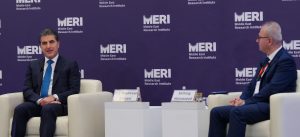
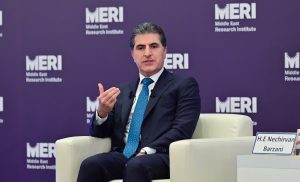
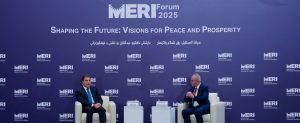
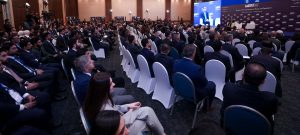
This panel features President Nechirvan Barzani in dialogue with peace-building expert Sarhang Hamasaeed on the strategic position of the Kurdistan Region within Iraq’s evolving political landscape and the wider regional and international context. Held at MERI Forum 2025, the discussion is anchored in the post-2003 transition and the 2005 constitutional settlement. It revisits the promise of Iraq’s federal experiment and examines why, nearly two decades later, many of its foundational objectives remain unrealized. Rather than treating Iraq’s challenges as isolated crises, the conversation situates them within a longer and unfinished process of state-building marked by contested federalism, weak institutionalization, and a persistent gap between constitutional design and political practice.
Throughout the discussion, President Barzani advances a consistent argument: the Iraqi Constitution remains the Kurdistan Region’s most significant political achievement, yet its non-implementation lies at the heart of Iraq’s structural instability. The panel then moves to touch upon elections, democratic legitimacy, economic sustainability, security governance, and regional relations, emphasizing the risks posed by armed actors operating outside state authority and by an unsustainable public-sector-driven economic model. At the regional level, the Kurdistan Region’s approach is framed as pragmatic and stability-oriented, prioritizing constitutionalism, political coordination, and long-term engagement, particularly with Baghdad, which is identified as the Kurdistan Region’s strategic depth. The thematic quotations that follow capture key elements of this discussion. The full exchange is available in Kurdish transcript form. The quotations under each theme have been refined to preserve their full contextual meaning.
- The Iraqi Constitution: Core Achievement, Core Problem
The constitution is framed as the single most important Kurdish gain after 2003, but also as the root of Iraq’s current dysfunction due to systematic non-implementation.
President Nechirvan Barzani stated that “I regard the Iraqi Constitution itself as a major achievement for the Kurdistan Region.” He then stressed that “the fundamental problem is whether this constitution has been implemented—and the answer is no.” Elaborating further, he noted that “all our disputes with Baghdad—oil, Article 140, the Peshmerga—stem from a single source: the constitution has not been implemented.” He later warned that “the gravest problem in Iraq today is that no one knows whether the system is truly federal or centralized.”
- Federalism vs. Centralization in Practice
While Iraq is constitutionally federal, it operates in practice as a highly centralized state, contradicting Kurdish expectations and comparative federal norms.
Barzani observed that “in day-to-day practice, Iraq is highly centralized, despite being labeled a federal state.” He added that “nowhere in the world does a federal government treat a region the way Baghdad treats the Kurdistan Region.” He further remarked that “Baghdad’s conduct toward the Kurdistan Region reflects an excessively centralized mindset.”
- Strategic Depth of the Kurdistan Region: Baghdad
The Kurdistan Region’s future is structurally, rather than tactically, linked to Baghdad, despite persistent tensions.
Emphasizing the long-term nature of this relationship, Barzani stated that “the strategic depth of the Kurdistan Region lies in Baghdad.” He went on to say that “we must reach an understanding with Baghdad, not as a maneuver, but as a long-term necessity.” He further stressed that “safeguarding this strategic relationship with Baghdad is critically important.”
- Elections and the Democratic Process in Iraq
Elections are presented as flawed yet indispensable as it is the only legitimate mechanism for political change.
Barzani described the elections as “the most consequential since 2005.” He underlined that “democracy is not a gift; it is a daily practice.” He then asked, “if we abandon elections, what is the alternative?” before affirming that “Iraq will not return to dictatorship.” He concluded by stating that “elections remain Iraq’s sole mechanism for political change.”
- Kurdistan Regional Elections and the Government Formation Crisis
The Kurdistan Region’s elections are framed as successful and peaceful, while delays in government formation are attributed to mistrust and power-sharing disputes.
Referring to the regional elections, Barzani noted that “voter turnout reached nearly 72 percent.” He highlighted that “two major parties held mass campaigns without a single clash—this in itself is a significant achievement.” He then acknowledged that “in my view, the government should have been formed much earlier,” cautioning that “there is a deficit of trust that must be addressed.”
- Armed Groups Outside the State and Sovereignty
The primary threat to Iraq’s stability is identified as armed actors operating beyond legal and constitutional authority.
Barzani warned that “the real danger to Iraq comes from forces that carry weapons outside the framework of the law.” He emphasized that “no armed group receiving state salaries has the right to conduct drone attacks.” He then insisted that “these forces must be brought under the law and placed under the Prime Minister’s chain of command.”
- Economic Model Crisis and Youth Unemployment
Iraq’s public employment model is depicted as fiscally unsustainable, particularly in light of rapid youth population growth.
Addressing the economy, Barzani stated that “Iraq requires nearly six billion dollars every month solely to cover public sector salaries.” He added bluntly that “no country can be governed in this manner.” He then emphasized that “the true engine of economic development is the private sector,” and noted that “Iraq has moved from a phase centered on security and it is time focus on job opportunities and employment.”
- Corruption and Institutional Weakness
Corruption is acknowledged as systemic and culturally embedded, requiring long-term institutional reform rather than quick fixes.
On corruption, Barzani stated that “I cannot claim that corruption does not exist.” He cautioned that “corruption cannot be eradicated overnight,” adding that “it is deeply connected to institutional structures and societal norms.”
- Drone Warfare and the Transformation of Security
Drone attacks are portrayed in the discussion as a new form of warfare that undermines sovereignty, deterrence, and investor confidence.
On this, Barzani stated that “those attacking the Kurdistan Region do so using explosives and missiles.” He emphasized that “this is not merely a threat to the Kurdistan Region, it is an assault on Iraq’s sovereignty.” He added that “Baghdad’s response has been marked by serious negligence.”
- Regional Relations: Iran, Turkey, Syria, and the United States
Iran:
On Iran, Barzani stated that “Iran is an important neighbor, and we do not seek to be a source of threat to it,” adding that “our trade relations amount to nearly eleven billion dollars.”
Turkey & the PKK:
On Turkey and the PKK, he stated that “the renewed peace process represents a historic opportunity,” warning that “delaying tactics and political games risk undermining the process and the Kurdish population.”
Syria/Rojava:
Addressing Syria, Barzani stated that “Syria is having the last chance of revival”, noting that “Syria cannot be governed through centralization, given its divers makeup” He added that “my message to my Syrian brothers is that they should establish a solid presence in Damascus as soon as possible, raise Syrian flag, own the political process, open an office in Damascus, and become strong stakeholders in the political process.”
United States:
On relations with Washington, Barzani noted that “We support President Trump’s policy to achieve peace in the Middle East, and we support efforts to ensure that peace is established in Gaza as soon as possible,” noting that “the relationship with the new US administration presents more opportunities than risks,” while also adding that “without the support of the international community, led by the US, ISIS could not have been defeated.”
- Final Message to Kurds and Iraqi Politics
Political responsibility, participation, and Kurdish coordination in Baghdad are emphasized as decisive for the next phase.
In closing, Barzani stated that “what is important is unity. We need to find and agree on a formula of collaboration, where Kurdistani parties work with each other across the opposition, the government, and others to achieve and preserve the important things we have in Baghdad.” He also stated that “the coming elections form a new chapter for Iraq and the KRI,” concluding with a hopeful note of “ Iraq entering a new phase and beginning a new chapter of construction, institutionalization, and resolution of the pending issues that Iraq has with the KRI.”
MERI Forum 2025
The Kurdistan Region’s Strategies amid Turbulent Regional and Global Dynamics