


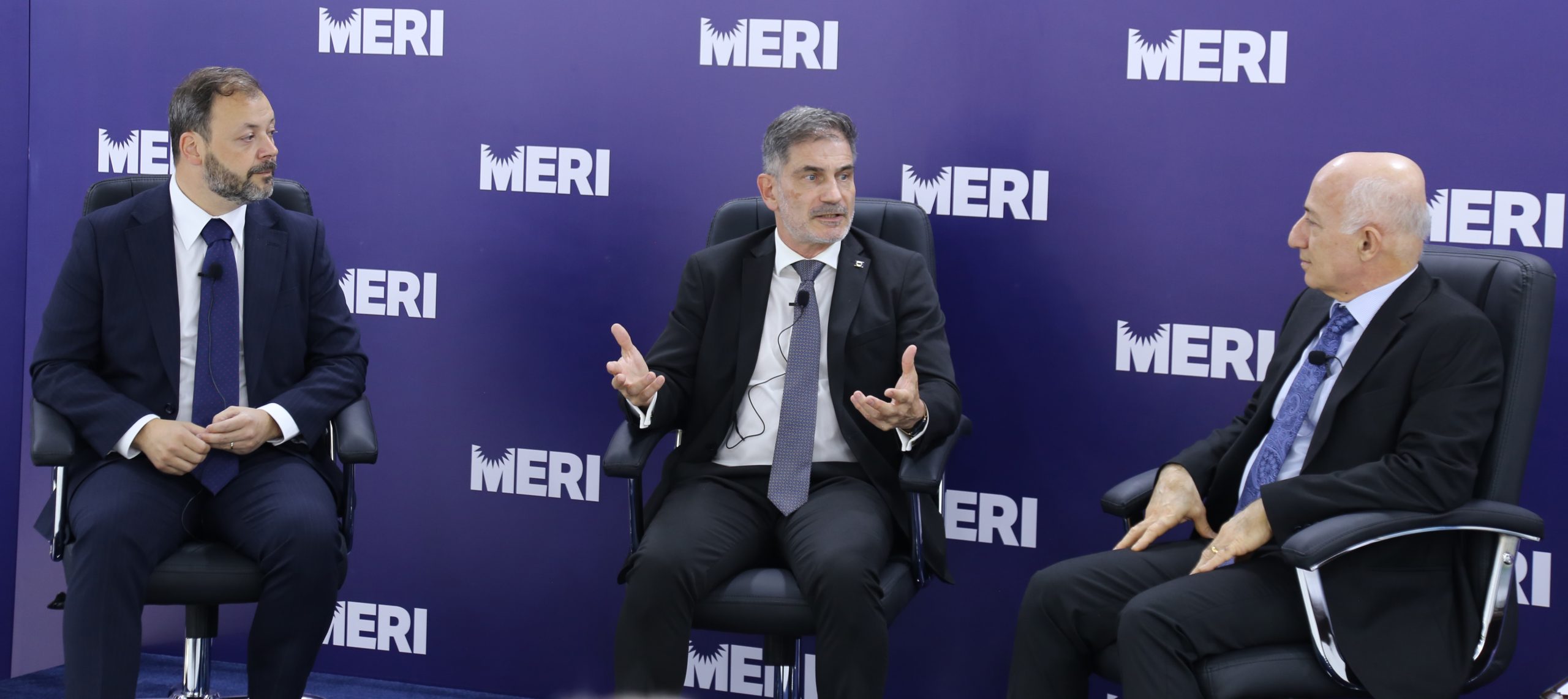
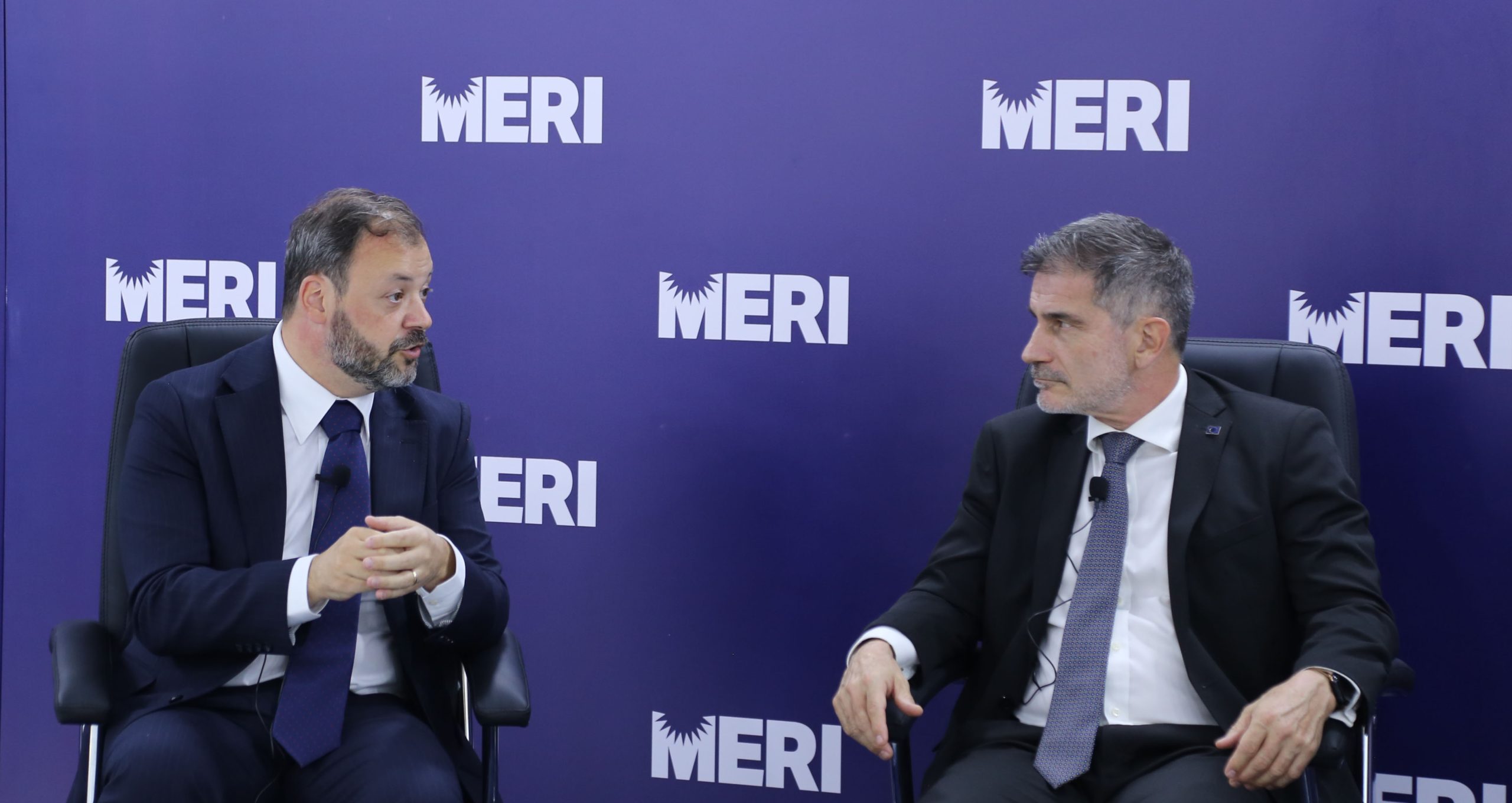
The Middle East Research Institute (MERI) hosted a policy discussion with Klemens Semtner, the European Union’s Ambassador to Iraq, and Radu Butum, Head of the EU Liaison Office in Erbil, marking the conclusion of Mr. Butum’s two-year tenure in the Kurdistan Region. Both speakers brought long familiarity with the Region to the table. Ambassador Semtner served as Germany’s Consul General in Erbil between 2020 and 2022 and Butum, closed two years of engagement across the Region’s institutions and communities as the Head of the European Union Liaison Office in Erbil
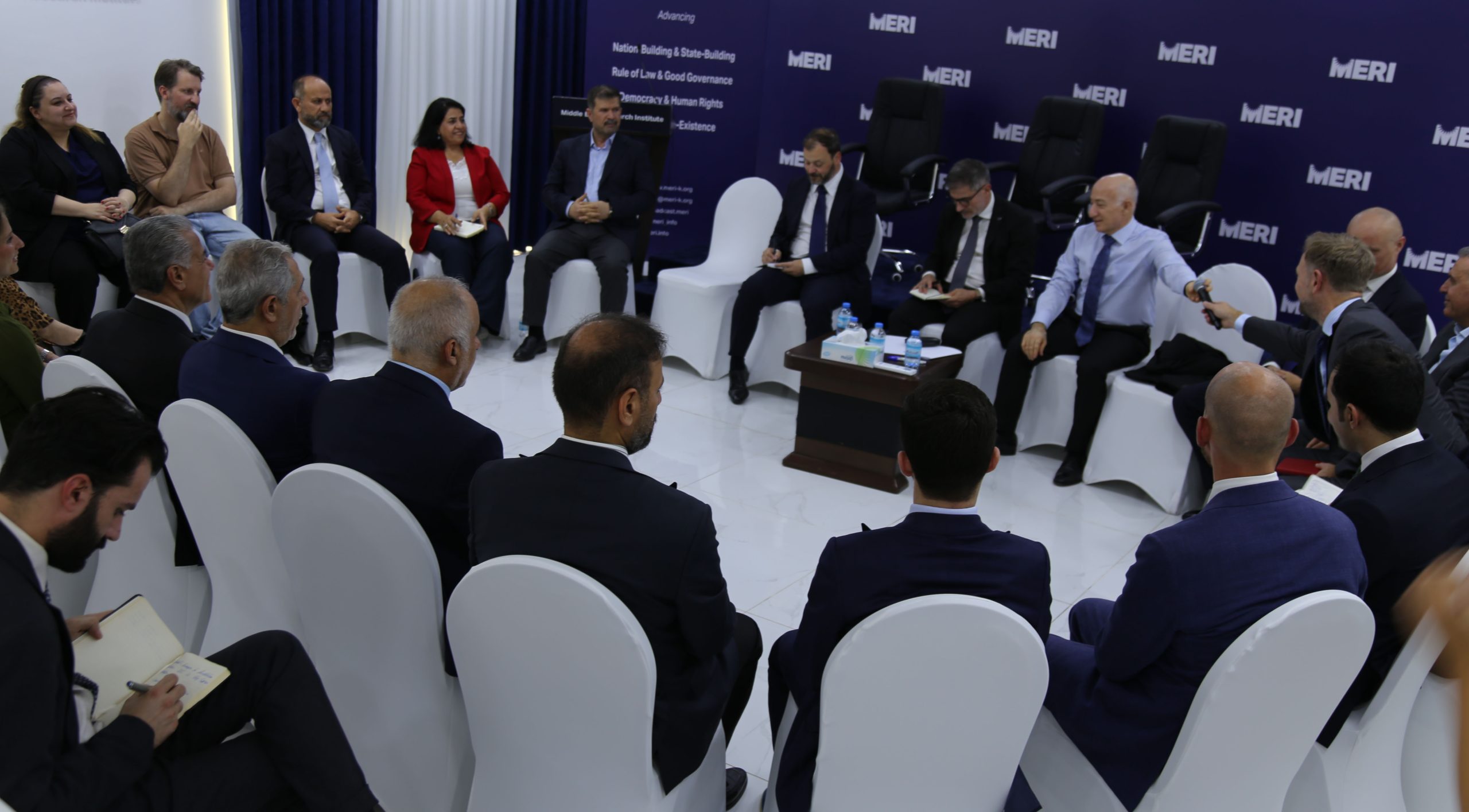
The event brought together senior officials, party representatives, diplomats, bankers, journalists and civil society figures. The first session was held on the record while the second part was conducted under the Chatham House Rule.* The discussion ranged across the European partnership framework, the disarmament of non-state armed groups, the coalition drawdown, migration, economic reform, Peshmerga unification and Baghdad–Erbil relations.
A Partnership Framework Finally Coming into Use
Ambassador Semtner opened up the debate by pointing to the Partnership and Cooperation Agreement signed in 2012, two years before the emergence of ISIS. The agreement is comprehensive, covering trade, industry and energy alongside democracy and human rights, but in his words it “was never really filled with life as it should have been,” given the war on ISIS. Yet, The ministerial Cooperation Council held in Luxembourg in October 2025 was the catalyst which reactivated the framework.
That reactivation coincides with a deliberate change of phase, the ambassador noted. For a decade European engagement was organized around stabilization: humanitarian assistance, the return of the displaced, and reconstruction in war-torn areas such as Mosul. Both the European Union and the Iraqi government now judge that phase to be closing. What replaces it is an economic agenda framed as an offer rather than a prescription, built on the argument that Iraq must diversify its economy. The constraints on doing so were named directly: overdependence on oil, a bloated public sector, weak private investment, an unreformed banking sector, an untrained young workforce, climate pressures and entrenched corruption. Regional volatility, including around the Strait of Hormuz, has made that argument harder to postpone, and in his assessment better understood on all sides in recent months.
The shift asks considerably more of Iraqi institutions than reconstruction ever did. Stabilization addresses consequences; development addresses causes, and therefore touches budgets, employment policy, regulation and how resource revenues are captured and distributed. Some 250 bills await completion in the Council of Representatives, several determining directly whether investment arrives, and the EU Delegation has written to the new Speaker identifying those they regard as consequential. Of the seventy to eighty banks operating in Iraq, most need to upgrade their services. As a result, it can be assumed that fewer institutions will remain able to work as banks. On EU financial resources, expectations were framed carefully: the 2021–2027 funding cycle is concluding with allocations largely committed, and the 2028–2034 cycle remains under negotiation among member states.
Values and the Limits of Like-Mindedness
Reflecting on his experience in the KRI, Mr. Butum characterized it as a broadly like-minded interlocutor, most visibly at the level of values, pointing to cooperation on implementing the Region’s human rights strategy following this year’s Universal Periodic Review. He drew a further parallel on security: the Region has consistently maintained that it is not a party to the wider regional conflict, and the European Union, facing provocations at its own borders, occupies a comparable position and has endorsed that stance plainly. He noted that the European presence in Erbil combines the Liaison Office and the EU Advisory Mission which deals with security sector reform, counter-narcotics and organized crime, and a humanitarian office focused on displaced persons, vulnerable groups and minorities.
Like-mindedness at the level of values, however, is not convergence at the level of institutions. Shared commitments to rights and pluralism in the KRI coexist with contested constitutional arrangements, unconsolidated security forces and an unresolved internal political settlement.
Disarmament and the Absence of a Political Process
On non-state armed groups, the Ambassador was unequivocal about the principle. The state should hold full control of arms, and attacks on embassies, consulates, government facilities and the residences of Kurdish politicians were “absolutely unacceptable.”
He was equally clear that principle does not substitute for process. Understanding where the armed groups come from, including the long history of Shia marginalization invoked by them to justify their actions, is not the same as justifying them, and some are evidently directed from Iran. But comparable processes of disarmament elsewhere in the world have required a political agreement among all sides about what is to be accomplished, and no such agreement presently exists in Iraq. The 30 September date, on his reading, is now treated by the federal government as a beginning rather than a conclusion.
The conventional recognized sequence is disarmament, demobilization and reintegration, and European offers of expertise have been made repeatedly. What was noted as conspicuously absent from Iraqi planning is the third element. The intention appears to be dissolving groups as units, absorbing them into the regular forces, and pensioning off the remainder, with almost no provision for retraining fighters into civilian employment. That omission deserves attention: absorption and pensions redistribute personnel without necessarily altering the loyalties that make armed groups politically useful.
The Vacuum That Should Not Be Filled
With the counter-ISIS coalition concluding, the panel was repeatedly asked whether Europe would step into the space left by the United States. Ambassador Semtner declined the framing. Europe knows how directly it absorbs the consequences of instability in Iraq, through migration and through terrorism, and considers that European states have shown their commitment. But on substitution he was unambiguous: “I don’t see it.” The Iraqi government is trying to establish that only the state may hold arms, and the armed groups justify their existence partly by the presence of foreign forces. Announcing that American troops have gone only to be replaced by Europeans would hand those groups their argument back.
On NATO’s presence, the Ambassador pointed to the important role of the United States providing the enabling infrastructure that operations depend on, airlift, intelligence, surveillance, logistics and command systems, while European members contribute forces that operate within it. More generally, European states are now responding through substantial increases in defense spending and joint capability programs, driven mostly by the war in Ukraine.
The coalition’s departure was requested by Iraq, in keeping with a wider effort to remove arrangements that looked like foreign tutelage. Iraq has claimed full control of its own security; it has come a long way to build the capacity that control requires. The sense of protection conferred by uniformed foreign personnel, felt particularly in the Kurdistan Region, has no obvious replacement for now.
Migration: A Symptom, Not a Policy Problem
Migration was discussed as a governance question rather than a border question. Despite the fact that applications from Iraq have fallen substantially, Iraq was still the second largest country of origin in one of the European countries in 2024. The working assumption among European missions is that three-quarters or more of the applicants originate in the Kurdistan Region, with Zakho, Chamchamal and Ranya named repeatedly.
The proposal that legal, contract-based labor migration might displace irregular migration met a sympathetic but skeptical response. Such schemes are national rather than EU competences, and the record is poor when understood as cyclical migration, i.e. establishing a system that assures long-term return of legal migration to avoid brain-drain: earlier circular migration programs involving Tunisia and Vietnam foundered because guaranteeing employment years after return proved administratively impossible. Beneath this often sits a mismatch between ambitions, skills and the labor market. It is common in Iraq to see graduates protest for public sector employment that ministries state does not exist, while construction sites are staffed almost entirely by foreign workers. European programming reflects that reading, concentrating on small and medium enterprises, access to finance, digital and green skills, and initiatives such as the MOVE project in Dohuk connecting training with market demand. The issue of Syrian refugees in the Region was raised in the reversed sense: their labor market contribution is substantial, forced return is neither lawful nor practical, and European facilitation has focused on documentation and verification, on the reasoning that people cannot decide to go home until their home stabilizes.
Kurdistan: Legitimacy, Voice and the Problem of Trust
Mr. Butum was measured but unmistakable on the Region’s internal situation. The European Union does not prescribe solutions, but what matters most when a range of scenarios remain open is establishing predictability at the internal political level which is a responsibility resting with the authorities here. Elections were held two years ago; the leeway that followed has narrowed, and stability and legitimacy in the proper sense are needed sooner rather than later. His argument turned on social cohesion, which legitimate institutions sustain and prolonged uncertainty places at risk. The Region’s greatest resource, he concluded, is its young and capable population, and the task is creating conditions in which they can make the most of where they are.
Ambassador Semtner, on his turn, offered a historical observation with a sharp edge. When he began working on Iraq in 2008, the files invariably described the Kurds as kingmakers in Baghdad. He does not read that anymore, and attributed the change substantially to weakened cooperation between the Region’s two major political parties. His counsel was that both should be heard in Baghdad as a single voice, and that on matters of self-evident national interest the Kurdistan Regional Government would do well to engage proactively. The ASYCUDA customs system, implemented in some ninety countries, was his example. He balanced this with the recognition that the oil route to Ceyhan currently constitutes Iraq’s only functioning revenue lifeline.
On Peshmerga unification the discussion recalled the scale of the earlier efforts, extensive German, British and wider Western engagement, elaborate plans and systematic work, which all later stalled. Nineteen units have since been unified; the deadline passed last year and was extended by a further year. The diagnosis reached past the Peshmerga to the intelligence services and special forces maintained separately by both parties, and rested on a deficit of trust: neither party will relinquish a capability it may need to defend its position. International partners can support functions and technical issues, but function does not follow form. The debate moved then to Iran-affiliated groups and elements of the Sadrist movement: organizations can be formally dissolved and personnel reassigned while political loyalties may persist intact.
The same difficulty surfaced when a question from the floor asked how European assistance delivered through state institutions is prevented from reaching actors who have penetrated them. The answer was candid about the limits: European practice is to work with institutions rather than individuals, and the EU Advisory Mission does not engage the Popular Mobilization Forces in its security sector reform work, but there is limited control of members passively participating if chosen by the Iraqi side. That defines the outer boundary of what institutional partnership can accomplish where capture has already occurred.
From Stabilization to Institutional Partnership
The European Union is moving from stabilization to a development partnership at a moment dominated by an important unresolved question: whether the Iraqi state will establish control over the armed groups operating outside it. How that is settled will contribute shaping the political process, the investment climate and the credibility of every other reform discussed over the debate.
For Baghdad, sovereignty asserted must become sovereignty exercised. Disarmament without a political agreement and without genuine reintegration will produce announcements rather than a monopoly over force
For the Kurdistan Regional Government, the message was consistent across both speakers: legitimacy and functionality are not merely domestic goods but the currency of external influence. Two years after elections, unresolved internal arrangements weaken the Region’s voice in Baghdad, complicate its case with European partners, and place social cohesion itself at risk.
For European partners, the challenge is remaining consequential without the coalition framework that once organized their presence. This means coordination and political visibility rather than substitution, and recognizing that migration, investment, security and governance are one problem approached from different directions.
The unifying theme was expressed most economically by the Ambassador himself: function does not follow form. Iraq and the Kurdistan Region are not short of agreements, strategies, deadlines or organigrams. What remains scarce is the trust that makes institutions work as designed, and that is the one thing no external partner can supply.
*The first session was held on the record. Except for statements made by Ambassador Semtner and Mr Butum during that open session, all other statements are unattributed and should not be affiliated with any participant.