


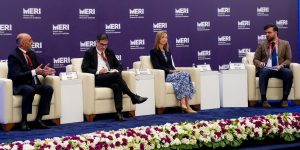
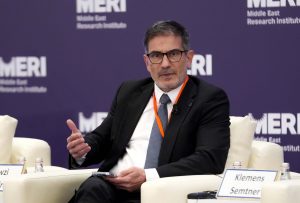
- Klemens Semtner, Ambassador of the European Union to Iraq
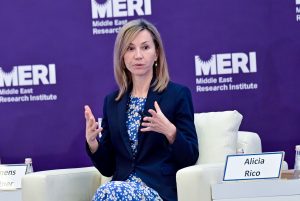
- Alicia Rico, Ambassador of Spain to Iraq
- Fawzi Hariri, President of the Diwan, Kurdistan Region Presidency
- Moderator: Khogir Wirya, Senior Research Fellow, Middle East Research Institute (MERI)
Setting the Stage
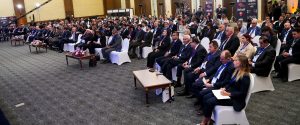
Moderated by Khogir Wirya, this high-level panel examined Iraq’s evolving engagement with international partners and the shared responsibility for sustaining stability, economic development, and institutional reform. Wirya framed the discussion around a central duality: how international partners perceive Iraq and the strategies they pursue, versus what Iraq itself seeks from these partnerships and what steps it must take to improve them. The panelists articulated their respective visions and challenges, setting the tone for a frank and constructive exchange that spanned diplomacy, economics, governance, and security.
The European Union’s Long-Term Vision: From Stabilization to Development
Opening the discussion, Ambassador Klemens Semtner underscored the European Union’s enduring commitment as a “reliable and consistent partner” to Iraq and the wider region. He recalled that the relationship is governed by the 2012 Partnership and Cooperation Agreement, which provides a comprehensive framework for cooperation across political, economic, and social dimensions.
According to Semtner, the EU has been allocating roughly €500 million annually to Iraq over the past decade in humanitarian, stabilization, and development support. However, this portfolio is now shifting from post-crisis recovery to long-term development, reflecting Iraq’s transition to a new phase. He announced that the upcoming EU–Iraq Cooperation Council in Luxembourg will focus on advancing this agenda, ensuring inclusivity by involving the Kurdistan Region of Iraq (KRI).
The EU’s core priorities, he explained, are clear: “We want a stable, peaceful, territorially integrated Iraq that is democratic, prosperous, and free of the scourges of migration crises and violent extremism.” He further highlighted the EU’s support for Iraq’s aspiration to become a regional actor, citing the Development Road Project as an opportunity to link Iraq to Europe through Turkey under the EU’s Global Gateway Initiative.
Semtner stressed that the EU’s engagement is increasingly geared toward economic diversification and investment, with institutions such as the European Investment Bank and European Bank for Reconstruction and Development (EBRD) playing a larger role. Beyond funding, however, he drew attention to Iraq’s most powerful potential driver of progress: “Young Iraqis are tired of sectarian narratives, they want jobs, dignity, and a future. We are here to support that.”
Spain’s Perspective: Rules-Based Partnership and a New Economic Era
Ambassador Alicia Rico began by placing Iraq’s engagement within a broader geopolitical transformation. The world, she observed, has evolved “from bipolar to unipolar, and now into a fragmented multipolar order,” one in which traditional alliances and partnerships are being redefined. Amid this flux, she warned, the rules-based international order—anchored in the UN Charter since 1945—is under serious strain.
For Spain and the EU, she argued, defending that order remains the foundation of all partnerships: “We want a relationship with Iraq based on peace, negotiation, and dialogue, not confrontation.”
Rico noted that while Iraq’s security challenges have dominated the international agenda, it is time to recognize that the country has entered a new phase. “The Kurdistan Region had a head start in modernization and openness,” she acknowledged, “but now Iraq as a whole is progressing.” The focus, she stressed, should shift from security assistance to economic and institutional development.
She emphasized the importance of good governance, institutional integrity, and the rule of law, calling them prerequisites for sustainable partnerships. Spain’s role, she added, extends beyond its participation in NATO’s advisory mission: “We want to promote economic and commercial engagement, not only security.”
Rico described an expanding portfolio of Spanish investments and agreements, including €1 billion in sovereign guarantees and €300 million in loans signed during Prime Minister Mohammed al-Sudani’s visit to Madrid. Spanish companies, she noted, are already working in railways, cement and gypsum factories, and infrastructure projects across Iraq, including feasibility studies for rail links in Kurdistan.
She concluded with optimism about Iraq’s potential: “Iraq holds enormous leverage, its geography, population, and resources are unmatched. Few countries have such a unique opportunity to drive regional integration and prosperity.”
Iraq’s Foreign Policy in Transition
Fawzi Hariri provided a detailed historical and political overview of Iraq’s foreign policy evolution since 2003, dividing it into four phases. The first, from 2003 to 2012, he described as a period of “openness and reconstruction”, supported by the Coalition Provisional Authority and early engagement with Western partners. Subsequent phases, however, were marked by political fragmentation, the decline in diplomatic professionalism, and growing interference by domestic actors. “In Iraq,” Hariri remarked wryly, “a foreign minister doesn’t have one or two bosses. He has three hundred.” Political party leaders, parliamentarians, and institutional rivalries have made consistent diplomacy difficult.
Nevertheless, Hariri credited successive governments and foreign ministers, for rebuilding relations with countries that were once divided over Iraq’s 2003 war. He highlighted Prime Minister Sudani’s active diplomacy, including visits to the UAE, Spain, and the UK, as evidence of renewed international engagement. “Foreign policy,” Hariri emphasized, “is not separate from daily life. A successful foreign policy means an easier life for citizens.”
Managing Neighbours: Balancing Iran, Syria, and Turkey
Addressing regional dynamics, Hariri stressed that Iraq’s diplomacy cannot be divorced from its neighbourhood. With Syria, he noted, Iraq continues to prioritize stability and inclusiveness: “Syria is not just an Arab country, it is a mosaic of nations that must be represented in any new government.”
He credited the Kurdistan Region with maintaining pragmatic relations across the region, from the Gulf to Turkey and Iran, while cautioning that each presents unique challenges. “With Iran, we now talk more about economic cooperation than politics,” he said, describing this as a sign of maturity. Regarding Turkey, he pointed to the evolution of relations since 2003 and the critical role of energy exports through the Ceyhan pipeline as “an indication of how far diplomacy has succeeded.”
Security, Sovereignty, and the Coalition Withdrawal
Turning to security, Hariri offered a candid assessment of the risks associated with the withdrawal of the Global Coalition to Defeat ISIS. While Baghdad views the threat as diminished, Erbil remains unconvinced: “ISIS may not control territory, but it still exists in pockets capable of destabilizing Iraq.” He emphasized that Kurdistan supports extending the Coalition’s presence until at least 2026, arguing that Iraq’s forces still depend on international partners for air cover, intelligence, and rapid mobilization. “Without these capabilities,” he warned, “Iraq will remain vulnerable.”
Hariri was equally frank about internal political tensions, particularly the budget dispute and the uneven allocation of federal resources: “Kurdistan’s constitutional share has fallen from 17 percent to less than 4 percent in practice,” he said. “Trust remains fragile.”
For Kurdistan, he argued, the path forward lies in unity and strategic coordination among Kurdish parties and in ensuring a stronger, institutionalized presence in Baghdad. “Strategic issues, budget, Peshmerga, and economy, must transcend party divisions,” he insisted.
Economic Governance and the Investment Dilemma
Returning to the theme of investment, Ambassador Semtner highlighted Iraq’s structural economic constraints. Chief among them is a weak banking sector and the dominance of state spending that “crowds out private credit.” He urged a transition toward small and medium enterprise (SME) empowerment, supported by European financial institutions and governance reform.
Addressing a key challenge in the Iraqi system, Semtner spoke openly about corruption: “It is embedded in the system of power sharing. Without reforming that foundation, progress will hit a glass ceiling.” The EU, he said, continues to prioritize transparency, capacity-building, and good governance in its partnership programs, but ultimate responsibility lies within Iraq’s own institutions.
Spain’s Perspective on Security and Reform
Responding to Wirya’s question about Spain’s role within NATO, Ambassador Rico clarified that Spain’s engagement extends well beyond security assistance. “Yes, we lead NATO’s advisory mission from 2026,” she said, “but our focus is now economic reform and private-sector development.”
Rico emphasized that Iraq’s structural reforms, especially in business climate and investor protection, are essential for unlocking foreign capital. “Investors need both security and predictability,” she said, adding that Spain is promoting not only foreign investment but also Iraqi entrepreneurship. She praised the government’s recent success in restoring stability: “There is no appetite among Iraqis to return to conflict. The priority now is jobs, growth, and reform.”
Global Politics and the Far Right in Europe
In response to Wirya’s final question on the rise of the far right and its potential impact, Rico acknowledged that Europe faces polarization but stressed that Spain has remained committed to openness and inclusion. “Our economy has outperformed the Eurozone precisely because we rely on openness, controlled migration, and free trade,” she said.
She contrasted this approach with rising nationalist tendencies elsewhere, reaffirming Spain’s belief in multilateralism and progressive engagement with the region. Rico concluded by underscoring Spain’s support for state authority and demilitarization in Iraq: “The state must have the monopoly of arms. We are concerned about drone attacks and the use of military assets outside state control.”
Reflections and Takeaways
This panel revealed a shared conviction among Iraq’s international partners: that the country has turned a page. While fragility persists, Iraq seems to be transitioning from survival to strategy, from stabilization to development.
Several core themes emerged:
- Partnership continuity: The EU and its member states remain invested in Iraq’s stability, linking their support to governance and inclusive economic growth.
- Shared responsibility: As Iraq redefines its foreign policy, it must also internalize reforms to ensure accountability and transparency.
- Regional balance: Pragmatic diplomacy with neighbours is crucial, but success depends on internal unity and institutional strength.
- Investment readiness: Economic diversification, rule of law, and investor protection are prerequisites for meaningful foreign engagement.
- Security evolution: The withdrawal of the Coalition heightens the need for local capacity-building and Kurdish–Baghdad coordination.
Ultimately, as Ambassador Semtner observed, Iraq’s progress will depend on “an honest debate about the future social contract among its diverse communities.” Ambassador Rico put it more simply: Iraq must leverage its geography and diversity to build prosperity, not division. And as Fawzi Hariri concluded, diplomacy is not abstract, it touches daily life. “A successful foreign policy,” he said, “means an easier life for the people.”
MERI Forum 2025
Partners and Progress: Iraq’s Shared Responsibility with the International Community