


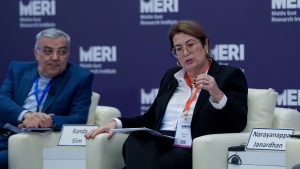
- Randa Slim, Foreign Policy Institute, Johns Hopkins SAIS – Washington
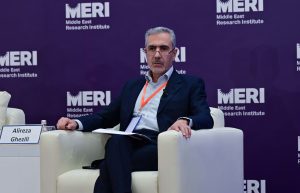
- Alireza Ghezili, Institute for Political and International Studies – Tehran
- Sayed Mohammad Hosseini, Former Iranian Ambassador to Saudi Arabia
- Narayanappa Janardhan, Anwar Gargash Diplomatic Academy – Abu Dhabi
- Moderator: Aniseh Tabrizi, Control Risks – United Arab Emirates
Setting the Scene
Moderated by Aniseh Tabrizi, the first session of the MERI Forum 2025 explored how the Middle East’s strategic landscape is being reshaped by shifting global hierarchies, regional ambitions, and changing external interventions. Tabrizi opened the discussion by noting that the region stands “in a chapter of war being paused but not closed,” characterized by growing fragmentation and instability, yet also by emerging opportunities for local actors to redefine their roles.
The panel examined whether the Middle East is truly moving toward multipolarity, where several powers share influence, or a looser, more fluid “minipolarity,” where influence is dispersed among mid-sized actors and mini-lateral alignments.
The United States: Retrenchment or Recalibration?
Randa Slim argued that despite frequent claims of U.S. withdrawal, Washington’s role remains central, albeit recalibrated. “The name of the game is unpredictability,” she remarked, recalling President Trump’s erratic statements on Gaza. What appears as retrenchment, she explained, is actually a shift from long-term military entanglements to “mega negotiated deals,” economic diplomacy, and selective uses of force.
Slim described the “Trump doctrine” as one defined by high-value economic agreements, such as those signed during his May 2025 Gulf tour, combined with limited military engagements and an emphasis on countering Chinese influence. “They are interested in a different form of projecting power,” she said, emphasizing intelligence sharing, drone operations, cyber capabilities, and outsourcing of security tasks to regional partners.
While the unipolar moment of the 1990s and 2000s has passed, Slim argued that the U.S. military presence remains “indispensable” as the key guarantor of security for many regional states and as the foundation of Israel’s military superiority. Yet the perception of U.S. withdrawal has opened space for Russia and China “to test the waters and develop their networks of allies.” The Middle East, she concluded, is now in a “transition toward fragmented multipolarity,” where regional powers play larger roles but still operate beneath a U.S. security umbrella.

The Gulf and the Rise of Geo-Economics
Narayanappa Janardhan countered Slim’s argument by claiming that the world is best understood today through geo-economics rather than geopolitics. While analysts still debate whether the global order is uni-, bi-, or multipolar, he observed that economically “it is unmistakably multipolar.” The combined GDP of emerging economies now rivals, and will soon surpass, that of the traditional G7, creating a system where power derives increasingly from markets and networks rather than from armies.
He described the emerging order as “multi-aligned, multi-networked, and multiplex,” driven by the agency of middle powers and even private corporations. “Just five big U.S. tech companies together form the world’s third-largest economy,” he noted, illustrating the diffusion of influence beyond states.
In this environment, Gulf countries have mastered multi-alignment. “Twenty-five years ago India’s foreign policy, good with everyone, seemed odd,” he said. “Today, the Gulf countries follow the same model.” Through diversified partnerships with the United States, China, Russia, India, and Europe, they have become “global Gulf” actors deriving influence from “capital, connectivity, collaboration, cyber and climate.”
Trade statistics underline the shift: Gulf–Asia trade now exceeds $750 billion, triple the Gulf’s trade with the U.S. and U.K. combined. Their foreign policy, Janardhan argued, has become pragmatic, transactional, and smart-power-driven, prioritizing geo-economic gains and mini-lateral cooperation (e.g., I2U2, UAE–France–India, South Korea–UAE). “In a multipolar world,” he quipped, “you can be on the menu and at the table at the same time.”
Iran’s Strategic Vision and the Quest for Multipolarity
Representing Tehran’s perspective, Alireza Ghezili suggested that the region may indeed be “on the brink of a transformation.” The past months, he said, demonstrated that the existing order, anchored in U.S. dominance, has failed to deliver peace or uphold international law. “Israel enjoys full endorsement of the U.S. administration,” he stated, while international institutions remain unable to restrain violations.
Multipolarity, in Ghezili’s view, offers an alternative to a broken order but raises unresolved questions: “Do we seek multipolarity for peace and stability? For economic development? Or simply to diversify our partners?” He asked whether Middle Eastern states wish to be “customers” or co-architects of the new order.
On Iran’s relations with Russia and China, he noted that Tehran has signed a long-term strategic framework with Moscow, recently approved by the Russian Duma, and continues to deepen cooperation with both powers. Yet China’s engagement, he said, remains primarily economic: “Energy, trade, and stability to sustain commerce.” Beijing’s neutrality and pragmatism have earned it credibility, but regional actors now expect it “to take more responsibility.”
Following the June 2025 strike on Iran, Ghezili confirmed that Tehran is “updating our defense capabilities” while insisting it “is not in favor of war.” The lesson, he said, is that deterrence must rest on self-reliance and diplomacy: “If you want peace, prepare for war, but pursue it through negotiation.”
Iran’s Diplomatic Posture and the Stability Paradox
Former ambassador Sayed Mohammad Hosseini placed Iran’s policy in a civilizational frame. Historically, he argued, Iran has been “a pillar of stability” and seeks a secure region as a precondition for its own prosperity. He praised China’s “positive intervention” in restoring relations with Saudi Arabia and reiterated Iran’s commitment to equality for all regional peoples, criticizing U.S. support for Israel’s actions in Gaza.
Yet when Randa Slim challenged how Tehran’s sponsorship of armed non-state groups could coexist with its professed quest for stability, Hosseini defended these movements as context-bound. “Al-Hashd al-Shaabi was established by the government and the religious authority to fight Daesh,” he said, while Hezbollah emerged in 1983 “in response to Israeli invasion.” As long as occupation persists, he argued, “resistance will continue.”
On Syria, Hosseini said Iran stands ready to restore relations with the new authorities, conditioned on respect for minority rights, territorial integrity, and prevention of terrorism’s return. Ghezili added that Iran’s presence in Syria was “not only military” but also economic, citing halted infrastructure projects such as power-plant construction.
Iraq’s Repositioning
A notable outcome of the recent 12-day war, Aniseh Tabrizi observed, was that all parties avoided drawing Iraq into the confrontation. Hosseini underscored the deep civilizational ties linking the two countries, emphasizing cultural and religious interconnections but also recognizing Iraq’s independent national interests. “Iran and Iraq are two states with their own interests,” he said, “but in strategic vision we look the same, we both want a stable region.”
From a Gulf perspective, Janardhan portrayed Iraq as a pragmatic partner rather than a geopolitical buffer: “It’s economic sense, not ideology.” The UAE alone, he noted, conducts roughly $40 billion in trade with Iraq and invests heavily in energy and infrastructure. He predicted that Iraq’s next growth phase would hinge on triangular cooperation among Gulf, Asian, and international partners.
China’s Expanding but Ambiguous Role
Returning to the external dimension, Slim emphasized that Washington’s current approach seeks to maintain its primacy partly by limiting China’s technological footprint, restricting 5G infrastructure, advanced-chip transfers, and imposing sanctions on partners who breach red lines. While acknowledging China’s success in mediating the Saudi-Iran rapprochement, she questioned whether Beijing is prepared for a broader strategic role: “Beyond economic diplomacy, there’s little evidence China is ready to expand its presence into security domains.”
Janardhan agreed that China’s mediation was symbolically significant but argued that it underscored U.S. complacency more than Chinese ascendancy: “Obama once proposed a cold peace between Riyadh and Tehran; China simply did what the U.S. never implemented.”
From Multipolarity to Minipolarity
Both speakers converged on the idea that mini-lateralism, small, purpose-driven coalitions, is reshaping regional governance. Janardhan noted that Gulf states have leveraged mini-lateralism to diversify trade, technology, and security ties outside slow multilateral institutions. These mini-lateral frameworks, he said, represent “re-globalization,” where supply chains, institutions, and rules are being rewired.
Slim agreed but cautioned that middle powers face “hard ceilings”: limited populations, rent-based economies, and constrained legitimacy, that prevent them from becoming rule-setters. “They can be facilitators or spoilers,” she said, “but not the ones defining the regional order.” Janardhan countered that Gulf states have learned to convert economic strength into “smart power,” balancing influence without overreach: “When you follow the economic perspective, you go laughing to the bank.”
Key Takeaways and Implications
The discussion revealed a Middle East no longer defined solely by the polarity of great powers but by multiple overlapping orders, economic, technological, and security, managed increasingly by middle actors.
- Perceptions of U.S. withdrawal continue to shape behaviors even as Washington recalibrates rather than retreats.
- Geo-economics now trumps geopolitics: Gulf and Asian interdependence dwarfs traditional Western linkages.
- Mini-lateralism and smart power are replacing grand alliances as vehicles for influence.
- China’s presence remains primarily commercial but could evolve if regional expectations of security guarantees grow.
- Iran’s doctrine of ‘resistance for stability’ remains contested, both normatively and practically, as non-state alignments complicate state consolidation.
- Iraq’s evolving partnerships illustrate the trend toward pragmatic, multi-vector engagement rather than ideological blocs.
As Janardhan concluded wryly, “Trump’s effort to make America great again may actually be making middle powers great again.” Slim, however, offered a tempered reminder: middle powers operate within limits; their influence is bounded multipolarity rather than true equality.
Between those two poles, multipolarity’s promise and minipolarity’s reality, lies the Middle East’s next chapter, one defined less by who dominates than by how actors navigate interdependence, hedging, and opportunity amid perpetual uncertainty.
MERI Forum 2025
Between Multipolarity and Minipolarity: The Middle East’s Evolving Power Landscape