


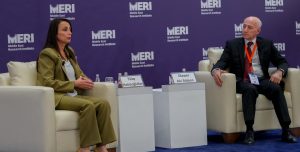
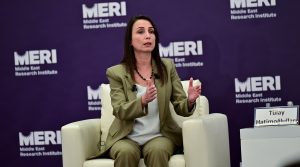
In a debate between a leading voice from Türkiye’s pro-Kurdish DEM Party, Tülay Hatimoğlulları, and MERI’s President Dlawer Ala’Aldeen a key question with implications far beyond Türkiye’s borders was explored: can a renewed peace process between the Turkish state and the Kurdish movement unlock a more stable, prosperous regional order in the Levant and Iraq?
The discussion moved between concrete developments in the peace track, the strategic recalculations in Ankara, and the regional theatre stretching from Gaza to Rojava. Throughout, there was a clear tension between deep scepticism born of past failure and a stubborn, almost necessary optimism that peace is still possible, if certain structural changes are made.
Why Peace in Türkiye Matters Beyond Türkiye
Ala’Aldeen framed the conversation by recalling the contrast between the earlier peace process and its collapse. During the years of dialogue between Ankara and the Kurdistan Worker’s Party (PKK), Türkiye was widely perceived, especially from Iraq, as a “gateway to the world”: a promising economic, political and infrastructural bridge for the wider region. When hostilities resumed, that promise turned into regional “disaster”. Iraq suffered, Türkiye suffered, and the reverberations destabilised the broader Middle East.
This framing is important. It treats the Kurdish question in Türkiye not as a purely domestic security issue, but as a regional structural variable. If Türkiye is at peace with its Kurds, it can act as a connector; if it is at war, it exports insecurity, through military operations, securitised borders, displaced populations and hardened ideological positions. In that sense, the stakes of the peace process extend to Erbil, Baghdad, Damascus and beyond.
Ala’Aldeen’s introduction also underlined the personal and political weight of his guest: Tülay has recently met both Abdullah Öcalan and President Erdoğan, and has just returned from witnessing the symbolic burning of PKK weapons in Sulaymaniyah. Tülay was therefore placed as a privileged interpreter of where the process stands and where it might go.
The Kurdish Question as a Century-Old Democratic Fault Line
Tülay situated the discussion in a long historical arc. The “Kurdish question” in Türkiye, she noted, is now over a hundred years old, as old as the Republic itself. Since the founding of the Turkish nation-state, the unresolved status of Kurds has been one of the principal obstacles to democratisation. She linked this to the broader post-Sykes-Picot settlement, which drew borders “almost with a ruler”, slicing Kurdish communities into four parts and separating families who once danced together at the same weddings.
From this perspective, what happens in Türkiye is inseparable from developments in “four parts of Kurdistan” and across the Middle East. The peace process is not simply about ending one insurgency; it is a potential pivot point for the entire region’s political evolution. It can either reinforce a model of centralised, homogenising nation-states, or open space for new, more plural forms of democracy.
Tülay recalled that the 2013–2015 peace initiative raised enormous expectations, not only among Kurds but across Turkish society, Turks, Arabs and other communities. Its collapse, accompanied by the October 6–8 events and the imprisonment of HDP co-chairs Selahattin Demirtaş and Figen Yüksekdağ, left deep scars and a residual fear of “being burned again”. That failure now hangs over every subsequent attempt at dialogue.
New Initiatives: Öcalan’s Call, PKK’s Dissolution Congress and the Weapons Burning
The current process, as Tülay recounted it, has several key milestones. On 27 February, Abdullah Öcalan issued a call from İmralı, framing peace as a democratic solution for Kurds in all four parts of Kurdistan within the existing borders of the states in which they live. His emphasis is on democratisation, human-centred governance, and the recognition of Kurdish rights, identity, language, and legal status, through peaceful fraternal methods.
In response, the PKK convened a “dissolution congress” and symbolically burned weapons in Sulaymaniyah- an event that Tülay described as historic. The symbolism matters: burying weapons means they can be dug up again; burning them signals a deeper, more definitive commitment to peace. Yet the ceremony also carried a concrete political message. It called for a special legal framework in Türkiye to enable fighters to disarm and transition into legal, democratic political life. Without such laws, the path from armed struggle to politics remains blocked.
This highlights an asymmetry that runs through the discussion: the Kurdish movement has taken visible, risky steps such as a public call from Öcalan, a dissolution congress, symbolic disarmament, while the Turkish state, in Tülay’s view, has been much slower to translate dialogue into binding legal and institutional guarantees.
State Responses: Parliamentary Commission, Political Prisoners and the “Right to Hope”
On the state side, Tülay noted one significant move: the establishment of a parliamentary commission which, by the time of the panel, has held fourteen meetings. The commission has been hearing from victims of conflict and from constituencies supportive of resolving the Kurdish question. For DEM, this is “very important” as a space for confronting history, recording experiences and facilitating mutual recognition of suffering.
However, she stressed that this remains incomplete without concrete legislative action. The DEM Party has been relentlessly pressing for such steps since parliament reopened on 1 October, in parallel with an intensive campaign by Kurdish women’s organisations such as TJA, which organised a nationwide march culminating at the parliament on 7 October. Their message has been clear: discussions alone are not enough; laws must change.
Tülay identified three clusters of legal and humanitarian priorities:
- A legal framework for disarmament and political integration– laws that spell out what happens to fighters who disarm and how they can participate in democratic politics.
- Öcalan’s “right to hope”– invoking a decision by the Parliamentary Assembly of the Council of Europe, she argues that prisoners who have spent 25 years in jail should be eligible for release. She emphasised Öcalan’s potential constructive role in promoting peace and democratisation across the region, and called for him to be able to work and speak freely.
- Political prisoners and ECHR rulings– she cited the European Court of Human Rights’ repeated decisions in favour of Demirtaş’s release and noted that Türkiye has instead filed objections, deepening public mistrust. She mentioned around 78,000 political prisoners, including many journalists, and called for comprehensive legislative change that would free both high-profile figures like Demirtaş and Yüksekdağ and ordinary political detainees.
The underlying argument was that trust is impossible if the state simultaneously talks peace and ignores domestic and international legal obligations regarding political prisoners. Every refusal to implement an ECHR ruling or release sick prisoners erodes the social base for the process. In this context, Tülay described DEM’s stance as one of “cautious optimism”: committed and hopeful, but explicitly conditional on concrete state action.

Party Dynamics, Strategic Recalculation and the Crisis of the Nation-State
Responding to Ala’Aldeen’s questions about the role of other parties such as AKP, MHP, and CHP, Tülay offered a revealing narrative: in her account, it was not the government but MHP leader Devlet Bahçeli who initiated the current phase, under pressure from shifting regional and global dynamics.
She linked Türkiye’s strategic rethink to a series of regional shocks: the Arab uprisings, the Syrian war and regime change in Damascus, the renewed Gaza war and intensified Israeli military activism across the region, Israel–Iran confrontation with nuclear overtones, and a more general drift towards a multi-polar order where energy corridors and strategic connectivity are being redrawn. Türkiye has already been excluded from one major proposed India–Europe corridor, which she presented as a warning sign.
Against this backdrop, parts of the Turkish “state mind” have concluded that unresolved internal conflict with Kurds weakens Türkiye’s hand in a rapidly shifting regional architecture. A state that is at peace with its own population, she argued, is stronger- whether in Türkiye, Iraq, Iran or Syria. Conversely, a state built around a hierarchical, exclusionary conception of a “superior” nation or religion is structurally brittle.
Here Tülay widened the frame to a full critique of the 20th-century nation-state model in the region. In her view, the internal crises of Iraq, Iran, Syria and Türkiye all stem, at root, from an ethno-nationalist, centralising conception of sovereignty. The solution, she argued, is a transition toward decentralised, democratic rule based on equal citizenship, underpinned by constitutional changes. This was where she introduced Öcalan’s concept of democratic confederalism: not a redrawing of borders, but a model in which each people and faith community can organise and represent itself freely within existing states, with guaranteed cultural and linguistic rights (including mother-tongue education).
In this schema, peace in Türkiye is not merely an end to armed conflict but the first step towards a broader transformation of governance in the region, away from hard nation-states and towards complex, overlapping networks of democratic self-government.
Seriousness, Guarantees and the Role of Öcalan
Ala’Aldeen repeatedly returned to the question that worries many in Iraq and the region: what guarantees are there that this process will not, like its predecessor, be instrumentalised for electoral needs and then abandoned, leading back to war and renewed Turkish military interventions in Iraq?
Tülay’s answer was blunt: the only real guarantee is political development, structural change in the way the state and political parties approach the Kurdish issue. There is no mechanical or external guarantee that can prevent backsliding.
She stressed three pillars that could reduce the risk of relapse:
- Cross-party embedding of the peace agenda
DEM has been investing enormous effort in engaging not only the ruling AKP and its ally MHP, but also the main opposition CHP and other parties. For the process to be durable, she insisted, every party represented in parliament must develop and own its own Kurdish peace policy. Peace cannot be a project of one government; it must be normalised across the political spectrum. - Öcalan’s indispensable role
Tülay was explicit that, in the eyes of both the PKK and much of Kurdish society, Öcalan is the primary negotiator and key leader. It was his call that made the dissolution congress and the weapons burning possible. The state understands this, she stated; friends and adversaries alike know how central his role is. For that reason, his freedom to act and speak is, in her view, one of the core “guarantees” that the process will be serious and coherent. - Domestic and international societal pressure
She called for strong support from civil society, democratic forces and social movements across the Middle East, Europe, Latin America and beyond, not only governments. International solidarity and scrutiny, she suggested, can provide an external “push” that encourages the Turkish state to stay at the course.
Yet even with these elements, Tülay refused to promise success. DEM is working “day and night” and sincerely believes in the process, but peace depends on the interaction between three actors: the state, the PKK and Öcalan. If their talks do not remain “healthy, productive and result-oriented”, there is always the risk of returning to square one.
Rojava, Syrian Democratisation and the Regional Feedback Loop
The panel then turned to Rojava, which Ala’Aldeen described as the space where the Turkish peace process will have perhaps its most immediate and visible external impacts. Rojava exists today because of the blood of its fighters, he noted; this sacrifice must not be squandered politically. At the same time, Türkiye rejects any formal recognition of Rojava as an entity and seeks its absorption into Syria, while also exerting pressure on Damascus and threatening Rojava militarily. Qandil’s decisions and the PKK’s posture also affect the equation. Öcalan’s messages to Rojava that the Kurdish question there must be solved as part of Syria, are therefore central.
Tülay was clear: developments in Rojava directly shape the peace climate in Türkiye, and vice versa. She criticised Ankara’s foreign policy for abandoning the “zero problems with neighbours” approach and embracing neo-Ottoman ambitions, leading to a situation in which Türkiye is in confrontation with many of its neighbours and deeply involved in Syria’s internal affairs.
Her proposed alternative was straightforward: Türkiye should support the democratisation of Syria, not contribute to its further fragmentation or militarisation. She described the current self-administration in North and East Syria as the only genuinely democratic experiment on the ground and recalls major atrocities against Alawites and Druze after the recent change in power in Damascus, as well as fresh tensions in Kurdish neighbourhoods of Damascus.
On the oft-repeated demand that the SDF should “integrate” into Syrian state structures, she offered a sharp critique: integrate into what, exactly? There is no clear, democratic, inclusive Syrian army or political order to integrate into. Elections have been narrow, excluding much of the country, and there is no functioning national constitution that recognises all components. Under these conditions, calls for “integration” are vague at best and potentially tools for re-centralisation without guarantees.
Instead, she argued, the self-administration is ready to be part of a democratic, decentralised Syrian state, built jointly with others. Its demand is not separation, but equal participation in a pluralist system that recognises Alawites, Druze, Syriacs, Christians, secular Sunnis and others in a shared constitutional framework.
Tülay added a powerful gendered dimension: she highlighted the Kobani resistance as the turning point in rolling back ISIS and emphasised the pioneering role of Kurdish women fighters and the women’s movement in Rojava. Their model of co-chairship, gender parity and feminist democratic practice have, she noted, been recognised and admired by women’s movements across 18 countries in the MENA region. For her, Rojava is not only a security and geopolitical issue, but a laboratory for democratic and gender-egalitarian governance in the Middle East.
Prospects: Between Necessary Hope and Structural Uncertainty
In the final exchanges, when asked whether she truly believed the process will solve the Kurdish question, Tülay answered with a mix of conviction and humility. She wanted very much to believe. Without genuine belief, she argued, no peace process can be sustained; scepticism becomes self-fulfilling. Her vision was of a Türkiye where 86 million citizens, including some 30 million Kurds, no longer feel like second-class outsiders but as equal, respected citizens.
At the same time, she refused to pretend that belief is enough. Peace is by definition a compact between former enemies; it depends on both the state and the armed movement translating their stated intentions into behavioural and institutional change. DEM Party can work tirelessly and sincerely, but unless negotiations between the state, PKK and Öcalan progress in a substantive and result-oriented way, the process could stall or even reverse.
She closed by situating the question in a wider transformation: in a world moving from a unipolar to a multipolar order, where power balances and economic corridors are being re-designed, Türkiye has a strategic need to make peace with its Kurds if it wants to position itself as a credible, stable regional actor. This is not simply a moral imperative; it is a calculation of long-term national interest.
Her final words in Erbil were both personal and political: gratitude for the space provided by MERI, and a hope that together, across borders and identities, the region can build a future based on democratic law, mutual affection, and equality, rather than hierarchy and violence.
For Iraq and the wider Levant, the message is clear: peace in Türkiye is not a side story, but a potential catalyst that could either enable or obstruct broader projects of regional connectivity, economic cooperation, and post-conflict recovery. The panel left no illusions about the obstacles, but it also refused surrender to cynicism.
MERI Forum 2025
Peace in Türkiye: A Catalyst for Stability and Prosperity in the Levant and Iraq
***
About MERI:
The Middle East Research Institute (MERI) is internationally ranked as Iraq’s leading think tank and policy research institute. As an independent, non-profit, grant-funded organisation, MERI advances evidence-based policymaking, democratic governance, and sustainable development through research, policy analysis, dialogue, and public engagement.
MERI’s research focuses on Iraq, the Levant and the wider Middle East, covering governance, state-building, foreign policy, regional security, post-conflict recovery, violent extremism, displacement, minority rights, women’s rights, civil society, Baghdad–Erbil relations, and broader geopolitical developments. Through its publications, policy dialogues, and the annual MERI Forum, MERI brings together policymakers, diplomats, academics, and civil society leaders to promote informed debate and practical policy solutions for the region’s most pressing challenges.