


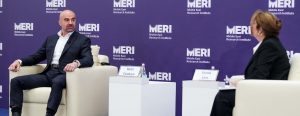
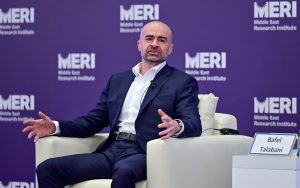
In this Policy Debate, Randa Slim, an analyst from Foreign Policy Institute, engaged Bafel Talabani, the leader of the Patriotic Union of Kurdistan (PUK) in a wide-ranging discussion that moved from intra-Kurdish politics and governance in the Kurdistan Region to Baghdad–Erbil relations, regional security files, and the evolving role of regional powers such as Iran and Turkey over internal Iraqi politics. Throughout the conversation, Talabani sought to project an image of a confident, reformed PUK and a forward-looking Kurdish leadership capable of contributing to Iraqi and regional stability. At the same time, his remarks also revealed some of the tensions and unresolved questions that continue to shape Kurdish and Iraqi politics.
PUK unity, party reform and the investment climate
Talabani began by rejecting the suggestion that the PUK is still mired in internal divisions. “There are no internal divisions in the PUK,” he asserted, describing the party as “more united now than it’s ever been” and pointing to electoral performance as his main evidence. Elections, he argued, are “the examination that [a] political party is put through, like a student at school,” and since the emergence of the new leadership, PUK votes have “increased exponentially” from one election to the next. He noted that, for the first time in many years, the PUK became the “number one vote winner and seat winner in the provincial elections,” and that in the last election their vote share rose by an average of 93 percent—although, he added, he remains dissatisfied until the PUK can again become “the number one party in the Middle East.”
This framing highlights a deliberate attempt to turn the page on a difficult period marked by succession issues following Jalal Talabani’s illness and death. The emphasis on resilience, “many political parties would have a difficult time surviving such traumas”, is an important part of the PUK’s current narrative. At the same time, observers might note that internal disagreements and factionalism have not disappeared from Kurdish politics, and that electoral performance alone does not fully capture the internal health of a party in a context where state resources, security leverage and patronage can influence outcomes.
On governance and the investment climate, he portrayed Sulaymaniyah as an example of relatively effective management under pressure. In the last three years, he claimed, “in the middle of a financial crisis with limited access to foreign investment,” Sulaymaniyah has seen “more projects…than even in the boom time of Kurdistan, when oil was plentiful.” He attributed this to “very very interesting ideas,” such as exchanging projects for other forms of value, but then moved quickly to what he called “the meat of it”: “Sulaymaniyah is open for business and when you come to do business in Sulaymaniyah nobody will tap you on the shoulder and tell you you can have this business if you give me 50% of it.”
This narrative seems to be intended to distinguish PUK-controlled areas from other parts of Iraq where investors frequently complain about informal “cuts” demanded by political or security actors. Presenting Sulaymaniyah as more predictable and less predatory is an important part of the PUK’s message to both local and external investors. However, it is also clear that the broader political economy of the Kurdistan Region remains highly party-centric, and that patronage networks have long been embedded across all zones, including PUK areas.
Pluralism, opposition and the judiciary
When Slim turned to the question of smaller parties and activists, referring to reports of opposition leaders being in jail, Talabani responded by highlighting Sulaymaniyah’s reputation as a relatively open space. He underlined that “it’s not an accident that every opposition party lives in Sulaymaniyah,” nor that “almost every political activists in Kurdistan and many active in Iraq find safety in Sulaymaniyah.” In his view, this reflects a political environment where opposition voices can operate more freely than elsewhere.
At the same time, he drew a clear distinction between general opposition activity and three individuals referenced by Slim. One, he said, had been convicted on “financial charges and personal charges” in what he described as an “open and extremely transparent court case.” Another faces “quite serious allegations” with “overwhelming evidence.” Referring indirectly to his cousin Lahur Sheikh Jangi and his circle, he stressed that “being a political leader doesn’t put you above the law” and that a political party “is not the shield against brigandry.” He cited “telephones, hard drives, drones, computers, weapons, ID cards…as well as Mr. Lahore’s own words” about having a militia and willingness to fight.
Talabani thus framed these cases as matters of criminal accountability rather than intra-party score-settling. For his audience, this message is meant to underline that the PUK is committed to the rule of law even when it involves powerful figures from within its own ranks. However, given the long-standing concerns about judicial independence and selective enforcement in both federal Iraq and the Kurdistan Region, these claims can be treated with caution and see these developments as having both legal and political dimensions. What the exchange makes clear is that the PUK leadership is keen to argue that Sulaymaniyah remains both a space for opposition and a place where, in its own view, legal processes can be applied to politically connected individuals.
Coalition government, PUK–KDP partnership and the problem of institutions
The conversation then moved to the stalled formation of a new Kurdistan Regional Government (KRG) cabinet. Slim quoted Talabani’s earlier statement that “the formation of the government will remain delayed until I’m convinced that it will be different from the previous one and capable of fulfilling our promises to the people.” He reiterated that he stands “firmly behind that quote.”
For Talabani, the issue is not simply which party controls which post, but the nature of the governing system. “It’s more about the system rather than positions,” he said. Since no single party has won decisively, a coalition is inevitable. This, he argued, requires genuine partnership rather than nominal participation: “do you want observers or partners? If you want partners, partner with us.” He recalled that when the PUK and KDP worked together, fighting Daesh and Al-Qaeda, liberating parts of Iraq, and writing the Iraqi constitution, “we’ve moved this place forward.” He rejected the idea of a de facto partition in which each party governs its own area separately, insisting that “nobody in Kurdistan wants that.”
When asked how “involvement” in decision-making should be operationalised, his answer focused on clarifying and respecting institutional roles: the prime minister’s authorities should be clearly defined, and ministers should have clearly defined powers as well. Talabani linked this to a broader diagnosis of the Kurdistan Region’s weakness: “the lack of institutions…we sometimes don’t even have institutions. We have personalities, that’s no way to run a country.” He also noted that many of his “friends in the KDP” recognise this and “want to move in this direction with us.”
The emphasis on institutions over personalities reflects concerns that are widely shared by Kurdish and Iraqi reformers. At the same time, the process of shifting from personalised governance to rule-based institutions is complex and will require changes from all major parties, including the PUK.
Relations with Baghdad: budgets, agreements and institutional statecraft
On Baghdad–Erbil relations, Talabani continued to highlight the importance of realism and institutionalisation. He criticised a recurring tendency on both sides to sign documents that are unlikely to be implemented: “we put our signature to documents that we know damn well won’t be successful…that’s the first thing we should not do anymore.” He cited the most recent federal budget agreement as an example, recalling that while many were pleased with it, he expressed reservations directly to Prime Minister Mohammed Shia’ al-Sudani: “they’re not gonna do this and neither are you. Why sign it?”
Instead, he argued for “real dialogue” and “real negotiations” that produce commitments both sides can genuinely fulfil. He suggested that too often “personalities, internal personality problems” become the core of the problem, overshadowing the underlying policy issues. Once again, his proposed remedy is more institutionalised interaction: “one institution dealing with another institution rather than one personality dealing with one personality.”
Despite his critical tone, Talabani was cautiously optimistic about the current moment. With oil exports resuming, salaries being paid and what he called a “good mood,” he described this as “a good chance for Kurdistan now.” He sees potential for a united Kurdish bloc to regain some of the rights many Kurds feel have been eroded, especially in the framework of upcoming Iraqi elections and subsequent government formation. His optimism is notable, given his acknowledgement that 70 percent of Iraqis currently abstain from voting due to dissatisfaction with the status quo, but it illustrates a belief that more coherent Kurdish engagement in Baghdad can still yield tangible results.
Elections, vote rigging and foreign money
The discussion then turned to election integrity. Whereas some earlier speakers at the Forum had argued that vote fraud had decreased in recent rounds, Talabani expressed more concern. “I’m worried about vote rigging, I’m worried about intimidation of voting,” he said, questioning where exactly fraud had declined. He referred to areas where certain parties reportedly gained more votes “than Saddam Hussein” and suggested it was fair to ask whether this reflected natural voter preferences or pressure on voters.
He also raised the issue of external funding, noting that “vast amounts of money” appear to be flowing from “different parts of the world” into different groups and parties, a trend he finds troubling. In that context, he drew a sharp distinction with his own party: “with pride I can say the PUK has not taken a dollar from any country and will not take a dollar from any country and that’s the way we need to be.”
State sovereignty, non-state actors and security sector reform
The question of non-state armed groups and state sovereignty was another key theme. Slim linked state sovereignty to control over “weapons” and decision-making on “war and peace,” and suggested that the PUK had “non-state armed actors.” Talabani answered firmly: “No we don’t.” He explained that references to forces outside the Ministry of Peshmerga often overlook the reality that the “70s forces and the 80s forces” are recognised units, “trained by Iraqis, trained by foreigners, trained by Americans,” even if the Ministry itself has yet to be fully unified. He said he was “not aware of any of these actors” as non-state formations, but invited a more detailed discussion if specific examples were brought forward.
By contrast, he was more explicit when discussing al-Hashd al-Sha‘bi. He distinguished between the “general” Hashd that contributed to the fight against Daesh and a set of “outlier groups,” several of which have been designated as terrorist organisations. For the latter, his position was clear: “they have to be integrated into the legitimate forces or they must be dismantled.” When asked whether the Iraqi state has the capacity to do so, he argued that the primary issue is political will rather than capability: “the state first needs the desire. Once the state has the desire, I think the state has the ability.” In his view, the middle of an election cycle is not the right time for such a major step; he implied that a post-election period may be more appropriate.
Talabani’s overall message on security is that long-term stability requires armed force to be brought under formal, accountable structures. At the same time, the debate about Peshmerga unification and the status of party-linked units remains sensitive. His insistence that PUK does not command “non-state” actors reflects how the issue is framed from within, but many international and local analysts still see significant room for further integration and depoliticisation of security forces.
Regional files: Syria, Turkey and the Kurdish question
The panel devoted considerable attention to regional dynamics, especially Syria. Talabani commented on recent fighting in Aleppo and credited both French diplomacy and specific Syrian actors for helping to calm the situation. Regarding the relationship between Damascus and the Syrian Democratic Forces (SDF), he argued that much depends on whether Damascus’ expectations are “realistic.” If they are, and if the central state can “hold itself together,” he is “optimistic” that an arrangement can be reached.
He outlined what he considered reasonable Kurdish demands in Syria: “some form of autonomy” for Kurdish regions, recognition and protection of Kurdish language and culture, and a security apparatus that is both “safe for us and acceptable for us as Kurds” while being integrated into national military and intelligence structures. In his view, “Syria also should not be subject to the whims of other countries,” echoing his earlier call for an Iraq whose political decisions are made “for Iraqis by Iraqis.”
When Slim observed that too much focus is placed on one particular Kurdish party within the SDF framework, he responded frankly: “because they’re not as relevant.” He illustrated his point with an anecdote from Sulaymaniyah, where teachers on hunger strike insisted on negotiating only with him because “you can get it done,” even though they had not voted for him. For Talabani, effective politics requires engaging with actors who have the capacity to deliver.
On Turkey and the PKK peace process, Talabani described himself as “genetically an optimist” and suggested that the process “as a whole has been agreed by both sides.” In his reading, the remaining obstacles lie in complex legal and parliamentary details rather than in a fundamental rejection of peace. He expressed hope that the necessary steps will be taken and that “everybody…on all sides” remains committed to the process. Regarding PKK disarmament, he said that “luckily” he does not have to make that decision himself, arguing that Abdullah Öcalan has “already made that decision to disarm” and that the PUK’s role is to “assist in any way that we can.” This allows him to signal support for peaceful resolution and stability without going deeply into the operational challenges such a process would entail for the Kurdistan Region and its relations with Turkey.
Iran, deterrence and the risk of regional war
The conversation on Iran provided insight into Talabani’s regional outlook. Responding to a narrative in Washington that Iran has been significantly weakened, he offered a more mixed assessment. While acknowledging that proxies like Hezbollah and Hamas have been “certainly…weakened,” he questioned whether this automatically means that Iran itself is weaker. He referred to what he called the “12 day war” and severe strikes on Iranian infrastructure, arguing that “there were very few countries in the world that could tolerate what Iran tolerated” and still retaliate rapidly. For him, this illustrated the depth and resilience of Iranian institutions, even if they do not mirror Western institutional models.
He also noted that external attacks can sometimes unify rather than fragment a society, reporting that Kurdish contacts in Iran felt these events “galvanized the people.” By comparing this to social behaviour he witnessed in the UK during the COVID-19 crisis, he suggested that outsiders sometimes underestimate the cohesion and endurance of Iranian society.
At the same time, Talabani was clear that this depth of relationship does not justify foreign control over Iraqi politics. Drawing on the experience of many Iraqi leaders who lived in Iran as refugees, he used his own gratitude toward the UK as an analogy to explain why emotional bonds matter. Yet he concluded firmly: “as much as I’m friendly with the Iranians…as much as I’m friendly with Americans, this is our country. We need to manage it, we need to run it. It’s not your job.” For him, the answer lies in a “patriotic Iraqi movement” that can gradually reduce overdependence on external actors and encourage the 70 percent of Iraqis who currently abstain from voting to re-engage.
On Iran’s deterrence and forward-defence thinking, he reported that Iranian officials expect the main risk of conflict to be with Israel rather than the United States, and that recent strikes have reinforced their sense that they can be attacked even while negotiating. “What is the point of negotiating if we can be struck at any time by Western weapons?” he asked, summarising their view. Talabani argued that addressing this concern will be essential if future negotiations are to succeed, and he expressed hope for renewed US–Iran talks, praising earlier American negotiators as “very respectful and smart.”
When asked where Iraq would stand in the event of an Iranian–Israeli confrontation, he could only express hope that Iraq would be spared, while acknowledging that “the potential is [things] could get bad here.” He stressed that such problems cannot be solved “with force of arms,” noting that “knowledge cannot be erased by force of arms” once acquired, and that managing that knowledge and capability through diplomacy is key.
The United States and the Trump administration
Finally, the discussion turned briefly to the Trump administration’s policy on Iraq. Talabani adopted a somewhat unconventional tone, highlighting what he saw as positives rather than focusing on familiar criticisms. He appreciated that “at least we get straight answers,” describing a “clarity of purpose” and “clarity of mission” in his meetings, even if the policy file was still being shaped.
He suggested that, deep down, he believed President Trump to be a “peacemaker” with “a lot of balls in the air” to manage. He emphasised that he values political leaders who are willing to make decisions, arguing that “sometimes not making the decision is worse than making the decision.” In his view, if Trump truly seeks “a more peaceful world,” the path may be difficult but is “easier to identify” than the alternative. He linked this to what he saw as Trump’s “bravery,” referring to the attempted assassination. While others might reach different conclusions about the administration’s record, Talabani’s remarks suggest that he prefers clear, direct engagement and that he values predictable interlocutors, even when there are disagreements on substance.
Conclusion
This dialogue offered a detailed window into how Bafel Talabani and the current PUK leadership seek to position themselves in Kurdish, Iraqi and regional politics. The main themes are consistent: an emphasis on institutions rather than personalities; a call for patriotic projects in Iraq and Syria less dependent on external interference; a vision of genuine partnership between Kurdish parties; concern about non-state coercion, election manipulation and foreign funding; and a preference for negotiated solutions over escalation in regional crises.
At the same time, the discussion also highlighted some of the structural challenges that will shape the coming period. The move from personality-driven politics to truly institutional governance remains unfinished. The unification and depoliticisation of security forces is still a work in progress. The balance between necessary external partnerships and the desire for sovereign decision-making continues to be delicate. And public distrust, reflected in low turnouts in the past, remains a serious concern.
MERI Forum 2025
Ambition Meets Complexity: The Kurdistan Region in a Shifting Iraqi Landscape
***
About MERI:
The Middle East Research Institute (MERI) is internationally ranked as Iraq’s leading think tank and policy research institute. As an independent, non-profit, grant-funded organisation, MERI advances evidence-based policymaking, democratic governance, and sustainable development through research, policy analysis, dialogue, and public engagement.
MERI’s research focuses on Iraq, the Levant and the wider Middle East, covering governance, state-building, foreign policy, regional security, post-conflict recovery, violent extremism, displacement, minority rights, women’s rights, civil society, Baghdad–Erbil relations, and broader geopolitical developments. Through its publications, policy dialogues, and the annual MERI Forum, MERI brings together policymakers, diplomats, academics, and civil society leaders to promote informed debate and practical policy solutions for the region’s most pressing challenges.