


- Nikolay Mladenov, Director General of the Anwar Gargash Diplomatic Academy
- Abdulla Al-Qadi, Director, Crescent Petroleum, UAE
- Zmkan Saleem, Institute for Regional and International Studies, AUIS (Moderator)
Setting the Stage: Iraq at the Heart of a Changing Region
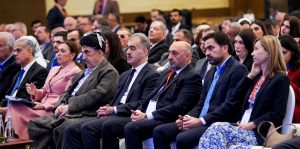
In this high-level panel on Iraq’s energy and economic diplomacy, the speakers explored how Iraq can leverage its resources, diplomatic position, and geographic location to become a major hub for regional integration and global connectivity. The panel was moderated by Dr. Zmkan Saleem from the Institute for Regional and International Studies the panel featured, and the panelists were Nikolay Mladenov, Director General of the Anwar Gargash Diplomatic Academy and former Special Representative of the UN Secretary-General in Iraq, and Abdulla Al-Qadi, Director at Crescent Petroleum. The discussion presented a candid and forward-looking examination of Iraq’s strategic options, the structural challenges confronting its energy sector, and the reforms needed to convert its oil wealth into sustainable economic development.
The panel opened with a reflection on Iraq’s unique position at the crossroads of the Middle East. Dr. Saleem noted that Iraq “sits at the heart of the Middle East geographically, economically and diplomatically,” making it a natural bridge between the Gulf, the Levant, and broader global markets. Yet, he also highlighted the political sensitivities around deeper Iraqi-Gulf integration, particularly given the domestic political divide and external actors who may resist such alignment.
From Confrontation to Convening: Iraq’s Multi-aligned Diplomatic Vision
Nikolay Mladenov started the discussion by arguing that Iraq is uniquely suited for what he called a policy of “multi-alignment.” To realize this Iraq will have to leave the path where it is a “spear or wall against Iran,” as this has required dictatorship and internal repression. Instead, Iraq can be a “convener,” a state that brings regional actors together given its geography, resources, and diverse population. The former model, exemplified by Saddam Hussein’s era, required constant internal enemies and centralized authoritarian rule, and ultimately led to disaster. The latter, he emphasized, offers a realistic, constructive alternative for a country that has suffered from decades of conflict.
Iraq’s natural and human resources, Mladenov continued to argue, position it to become a central actor in new security and economic arrangements emerging across the Middle East. By integrating energy policy, security considerations and diplomacy into a coherent multi-aligned strategy, Iraq can contribute to regional stability while advancing its own development. In Mladenov’s view, this model corresponds to the emerging role of “middle powers” whose security is not only defined by military strength but by the depth of their economic and diplomatic relationships, where all neighbors have a stake in its stability.
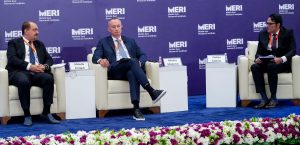
Diplomacy, Connectivity and the Need for Institutional Continuity
Mladenov stressed that this vision requires internal stability, improved governance, and a coherent legal environment that reassures Iraq’s partners. He pointed to initiatives such as the Development Road and GCC–Iraq–Jordan connectivity projects as examples of opportunities that could elevate Iraq to a regional hub, provided that political continuity and institutional stability are maintained. In his words, “memoranda don’t build railways”; implementation capacity, investor confidence, and secure governance climate are essential.
Dr. Saleem pressed further on whether top-level visits to Gulf capitals are enough to drive integration. Mladenov welcomed the diplomatic outreach but argued that broader institutional alignment is needed. Deepening trade liberalization, linking Iraqi infrastructure to regional corridors, and stabilizing the investment environment are, in his assessment, crucial next steps. He also highlighted a global trend of rising trade barriers, from roughly 250 in 2005 to more than 2,500 in 2025, warning that Iraq must respond by pursuing bilateral and regional agreements that preserve its economic openness. Ultimately, he insisted that energy, infrastructure, and economic policy must be embedded in a long-term, cross-party national framework that survives changes in government, ensuring continuity rather than abrupt policy shifts.
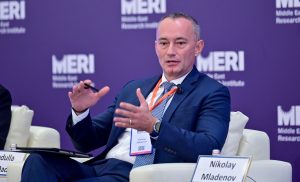
The Beating Heart of Energy: Opportunity and Vulnerability in Iraq’s Oil and Gas Sector
Turning to the practical challenges of Iraq’s energy sector, Abdulla Al-Qadi provided an insider’s view shaped by years of experience operating oil and gas fields in both the Kurdistan Region and federal Iraq. He began by noting Iraq’s historic role as “the beating heart of the energy sector,” with oil first discovered in Kirkuk more than a century ago. Iraq’s early development of the oil industry made it a reference point for the wider region, and its geological endowment remains enormous. While proven reserves are vast, the potential resource base is even larger, offering one of the world’s most significant opportunities for investment and development.
Yet, Al-Qadi argued that three structural challenges continue to hinder growth: the investment environment, security, and the role of the state as a partner in energy contracts. He stressed that although Iraq’s legal framework is, on paper, broadly adequate, inconsistent implementation frequently deters investors. Bureaucratic delays, unclear regulations, and the practical difficulties of applying legislation often translate into losses for companies. Many international firms have either left Iraq or scaled down their presence due to these uncertainties, although some are now gradually returning.
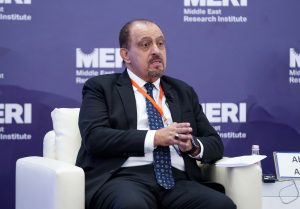
Investment Climate, Security Risks and the Role of the State
Security, in Al-Qadi’s assessment, constitutes a second major challenge. Recent attacks on oil and gas fields, especially in the Kurdistan Region, have created a sense of vulnerability that is difficult to reconcile with long-term, capital-intensive investment. He acknowledged the efforts of both the Kurdistan Regional Government and the federal government in Baghdad to support companies and stabilize the situation, yet underlined that “capital is fearful” and requires predictable, secure conditions to commit to large projects. Investor confidence is closely tied to the perception that such attacks are exceptional and effectively controlled rather than recurring threats.
The third challenge concerns the nature of public–private partnership in Iraq’s energy sector. In principle, the state is a partner in many oil and gas contracts, often with a defined equity share or oversight role. In practice, overlapping functions can create confusion when the state acts simultaneously as regulator, contractual partner, and sometimes quasi-operator. Al-Qadi argued for a clearer separation of roles: the state should focus on legislation, regulation, and revenue collection, while leaving day-to-day operations, financing and technology transfer to investors. Only then can partnerships be genuinely constructive rather than a source of friction and delay.
When asked about the level of guarantees provided against future attacks, Al-Qadi reiterated that private companies rely on the commitment and cooperation of both federal and regional authorities. He expressed appreciation for their support but also a firm expectation that additional steps would be taken to ensure that Iraq becomes a genuinely attractive and predictable investment destination.
Beyond Rentierism: Diversification, Governance and Climate Pressures
The conversation returned to Mladenov with a question on how Iraq can diversify its economy given its 90 percent reliance on oil revenues and the dominance of salary spending and politically motivated projects. He argued that without diversification, Iraq is “like a drug addict”, dependent on oil in a way that prevents structural reform and blocks long-term development. Oil wealth, in his view, has allowed the state to distribute salaries, but it has not produced a sustainable economic model.
He linked diversification directly to governance. The absence of an oil and gas law, the accumulation of unresolved legislative issues, and the difficulty in enforcing judicial decisions form a tangled legal and institutional environment that undermines investor confidence and strategic planning. For diversification to be credible, Iraq must first update and clarify its legal framework, modernize its judiciary, and ensure that regulations are predictable and enforceable.
Mladenov emphasized that climate change and environmental degradation are no longer peripheral issues. He noted that displacement in Iraq today is driven less by terrorism and more by lack of potable water, desertification and shrinking livelihoods. Deforestation, dust storms, and deteriorating water quality are already undermining social stability. In his view, any serious plan for diversification must integrate renewable energy, climate resilience, and environmental protection as core components rather than secondary concerns.
Gas as the Transitional Pillar: Unlocking a Neglected Resource
Al-Qadi expanded the discussion by highlighting the underdeveloped state of the gas sector. Developing gas fields, he explained, takes two to three times longer and costs two to four times more than oil fields. For illustration, a project requiring two years and a given capital outlay for oil might require four to six years and a multiple of that cost for gas. Despite Iraq’s enormous gas potential, 150 to 300 trillion cubic feet of recoverable gas, only one major company is currently investing in gas development, compared with dozens operating in the oil sector.
This imbalance, he argued, is rooted in the economic model embedded in existing contracts. Applying an oil-style contractual framework to gas is commercially unviable. Unless contract terms are recalibrated to reflect the higher cost, longer timelines, and strategic value of gas, investors will rationally choose oil projects, which are cheaper, quicker and more profitable. For Al-Qadi, revising the commercial terms of gas contracts is not about reducing the state’s share of benefits; rather, it is about designing a model that attracts investment and unlocks a resource that is essential for Iraq’s future energy mix.
He also pointed out that Iraq burns large volumes of associated gas despite recent improvements in capture and treatment. As Iraq increases oil production over the next decade, associated gas output will also grow, multiplying both the opportunity and the environmental cost if it continues to be flared. Transforming Iraq from a predominantly oil-producing country into one that is both oil and gas-based will require incentives for companies to invest in complex gas fields across Iraq, including in governorates such as Diyala, Anbar and in established gas-rich areas in the Kurdistan Region.
Learning from the UAE: Diversification, Connectivity and Best Practices
In the final exchange, Dr. Saleem asked what lessons Iraq can draw from the UAE’s successful diversification. Mladenov pointed to three critical elements. First, the reduction of dependence on hydrocarbons to around 30 percent of GDP, achieved through systematic efforts to build non-oil sectors. Second, the development of new industrial capacity, allowing the economy to generate value beyond raw resource exports. Third, the strengthening of connectivity through major investments in transport infrastructure and a dense network of free trade and partnership agreements spanning Asia, Europe and beyond.
These elements, he argued, are applicable to Iraq in adapted form. Iraq is ideally located to become a connectivity hub linking the Gulf, the Levant, Anatolia and Europe, yet this potential remains underutilized due to governance weaknesses and security concerns. While Iraq cannot simply replicate Gulf governance models, it can draw on best practices from the UAE, Europe and Turkey in areas such as infrastructure planning, trade policy and regulatory stability. Mladenov warned that the window for reform is limited: “The world will keep moving forward and nobody is going to stop and wait for Iraq,” he cautioned, underlining the urgency of building a broad national consensus around development priorities.
Balancing Energy Transition, Public Health and Economic Stability
The panel concluded with a question to Al-Qadi about how Iraq can balance its reliance on oil revenues with the imperative to protect public health and the environment, particularly in light of the harmful impacts of associated gas flaring. He acknowledged recent progress reported by the Ministry of Oil in increasing the share of treated associated gas and reducing flaring, describing this as an important step in the right direction.
However, he argued that as global production patterns shift, many countries will gradually reduce output, and OPEC will increasingly rely on core producers such as Iraq. This implies higher Iraqi oil production in the medium term, which in turn means more associated gas that must be captured, processed and utilized rather than burned. Given the scale of Iraq’s proven and potential gas reserves, he contended that Iraq has all the ingredients to become a major gas power in the region, matching or surpassing some neighboring producers whose reserves are smaller but current output is higher.
For Al-Qadi, the pathway to a balanced energy transition runs through serious development of the gas sector, supported by thoughtful incentives, streamlined procedures and a clear division of roles between the state and investors. Gas, he argued, is the essential bridge between a heavily oil-dependent system and a future in which renewables, solar power and other low-carbon sources play a greater role. The state should act primarily as legislator and revenue collector, while the private sector leads on financing, implementation and technology, within a framework of shared benefits where “everyone wins: the consumer, the state and the investor.”
Conclusion: From Battleground to Bridge
The session offered a rare combination of diplomatic perspective, technical expertise, and frank reflection on Iraq’s opportunities and constraints. Together, the speakers outlined a path toward a more integrated, diversified and sustainable Iraqi economy, one that positions the country not as a battleground for regional rivalries but as a convener, connector and constructive regional actor.
Realizing this vision will depend on Iraq’s ability to stabilize its governance framework, clarify its legislation, protect investors, and embrace a strategic approach to gas and renewables. If it succeeds, Iraq can translate its historical role as an energy pioneer into a new role as a regional hub for connectivity, cooperation and sustainable growth.
MERI Forum 2025
Iraq’s Energy and Economic Diplomacy: Regional Integration and Global Connectivity