


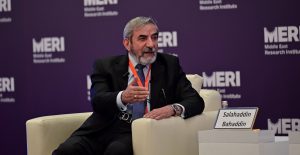
In a policy debate on the role of the opposition parties in the evolution of the political landscape in the KRI, President of the Middle East Research Institute (MERI), Dlawer Ala’Aldeen, engaged Salahaddin Bahaddin, Secretary-General of the Kurdistan Islamic Union (KIU), in a wide-ranging discussion exploring the challenges and prospects of political opposition in the Kurdistan Region of Iraq (KRI). The conversation offered a sober examination of the evolving relationship between power and opposition in a region where democratic institutions remain fragile and the constitutional framework is still absent.The KIU, established in 1994, is one of the region’s principal Islamic-oriented political parties. Known for its reformist and moderate outlook, the party has long advocated for moral governance, transparency, and peaceful political engagement, maintaining an oppositional stance within the Kurdistan Parliament while promoting dialogue and coexistence across ideological divides.
Setting the Scene
Ala’Aldeen sought to address the underlying question: how can a functional opposition exist and contribute to democratic growth within the current political system of the KRI? He stressed that, in the absence of a regional constitution, the roles of the legislature, judiciary, and opposition remain ill-defined, and that such ambiguity has constrained political pluralism and accountability.
The Structure and Health of Opposition
Reflecting on his decades-long political experience, Bahaddin described the existence of opposition as a natural and necessary feature of any political system. The real question, he argued, lies not in whether opposition exists but how authority and opposition interact, and that in Kurdistan, that relationship remains confused and unregulated. “We do not have a constitution or legislation that organizes this relationship,” he said. “In other countries, there are parameters and a path to follow. Here, the parameters are blurred, and that is very bad.”
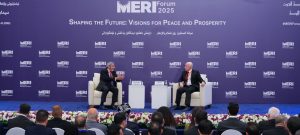
He observed that neither the ruling powers nor the opposition in Kurdistan function in a healthy way. The former monopolize authority, while the latter remain fragmented and occasionally at odds with one another. “Sometimes we even attack each other or accuse one another of being secretly aligned with the authorities,” he admitted. This internal disunity, he suggested, weakens the credibility of opposition parties and limits their ability to act collectively.
Bahaddin traced these problems to broader patterns in Iraq’s post-2003 political order, noting that the Kurdish political experience has mirrored the same deficiencies found at the federal level: the politicization of institutions, the erosion of professionalism, and the spread of patronage networks into families and individuals.
Power Monopoly and Political Apathy
Bahaddin argued that the ruling parties have become increasingly detached from both rival actors and the public at large. “They not only exclude other political parties,” he said, “but also avoid engaging with the people.” He described the political landscape as one defined by carelessness, unapologetic behavior, authoritarian tendencies, and unilateral decision-making, where crises are met with new crises rather than solutions.
While the opposition bears some responsibility for the state of affairs, Bahaddin emphasized that the greater share of accountability lies with the ruling elites, whose concentration of power has hollowed out institutional checks and democratic consultation.
Culture of Criticism and Civic Reform
Asked about his roadmap for revitalizing the opposition, Bahaddin used a metaphor: as long as hospitals and doctors exist, there is always hope of recovery. Likewise, despite the political malaise in Kurdistan, he insisted that reform is still possible through patience, perseverance, and civic engagement. The main obstacle, he argued, is cultural: criticism in Kurdistan is often treated as hostility. “If you criticize the authorities,” he said, “you are immediately considered their enemy. That is why we are going nowhere.”
He called for a transformation in political culture, one that values dialogue over tension, calmness over stubbornness, and cooperation over exclusion. “We need to abandon the notion of ‘I can do it without you,’” he said. “Progress requires mutual understanding and patience.”
For Bahaddin, the path forward must be peaceful, modern, and civil- not radical or violent. He urged all sides to identify shared foundations that can serve as the basis for coexistence: the nation, religion, moral values, and a long history of living together. Pitting communities or faiths against each other, he warned, is deeply wrong and dangerous.
Religion and Politics: Defining the Boundaries
Turning to the role of the KIU, Ala’Aldeen noted that, despite the predominantly Muslim composition of Kurdistan’s population, Islamist parties have struggled to expand their voter base. Bahaddin responded by emphasizing the need to distinguish between Islam as a religion and Islamic political identity. “Religion belongs to everyone,” he said. “If we monopolize it within a party, we go astray from its essence.”
He stressed that leaving or joining a political party does not equate to leaving or joining Islam itself. “It would be gravely wrong to claim that whoever is not part of our party is not religious,” he said. For him, the KIU’s approach has always been to draw inspiration from faith without conflating religiosity with political allegiance.
Parliamentary Dysfunction and the Need for Accountability
Discussing the role of the parliament, Bahaddin lamented its paralysis and criticized both the legislative and executive branches for perpetuating cycles of illegitimacy. He noted that the previous parliament had spent half its term in closed sessions and the other half extending its own mandate, an act later deemed unconstitutional by Iraq’s Federal Court. “It is shameful,” he said, “to do something that leads to the closure of one’s own parliament.”
He cautioned that any government emerging from such a process would lack credibility, adding that the failure to form a new government nearly a year after elections exemplifies the dysfunction of the current system. Despite these challenges, he ended on a cautiously hopeful note, pointing to regional peace efforts and the possibility of gradual progress toward stability and rights through peaceful means.
Conclusion
The dialogue between Dlawer Ala’Aldeen and Salahaddin Bahaddin provided a candid diagnosis of the structural and cultural impediments facing both governance and opposition in the Kurdistan Region. Bahaddin’s reflections underscored that while the ruling parties bear the primary responsibility for the stagnation of political reform, the opposition, too, must overcome its fragmentation and learn to operate with unity, patience, and civic maturity.
His call for calm engagement, mutual understanding, and a redefinition of the relationship between religion, politics, and power resonated as a reminder that democratic reform in Kurdistan will require both institutional restructuring and cultural renewal. In line with MERI Forum’s mission, the session offered a platform for open and critical dialogue on the future of governance and political accountability in the region.
MERI Forum 2025
Opposition, Governance, and Political Reform in the Kurdistan Region of Iraq
***
About MERI:
The Middle East Research Institute (MERI) is internationally ranked as Iraq’s leading think tank and policy research institute. As an independent, non-profit, grant-funded organisation, MERI advances evidence-based policymaking, democratic governance, and sustainable development through research, policy analysis, dialogue, and public engagement.
MERI’s research focuses on Iraq, the Levant and the wider Middle East, covering governance, state-building, foreign policy, regional security, post-conflict recovery, violent extremism, displacement, minority rights, women’s rights, civil society, Baghdad–Erbil relations, and broader geopolitical developments. Through its publications, policy dialogues, and the annual MERI Forum, MERI brings together policymakers, diplomats, academics, and civil society leaders to promote informed debate and practical policy solutions for the region’s most pressing challenges.